Showing posts with label Role-Playing Game. Show all posts

Monday, April 2, 2012

Review: Final Fantasy XIII-2

As I write this, I'm 32,000 feet in the air over the Pacific, 7 hours in to a 14-hour flight from Washington D.C. to Tokyo. I'm bored, hungry, and my eyes have desiccated to the point where my contact lenses would be more comfortable if I replaced them with Wheat Thins. Also, there's some sort of Japanese youth sitting next to me who keeps falling asleep on my shoulder. I can't think of a better time or place to write down some thoughts about my latest Japanese RPG experience, Final Fantasy XIII-2.


Final Fantasy XIII-2 (FFXIII-2) is a direct sequel to Final Fantasy XIII, and follows the exploits of time-traveling schoolteacher Serah Farron and her post-apocalyptic boy-toy Noel Kreiss. Serah is the younger sister of Lightning, the protagonist of Final Fantasy XIII... because if you're going to make a direct sequel within an expansive RPG franchise, it's a good idea to take the game with the least interesting cast, and then make an entire game about the least interesting character among them.

Design: 4/5

One of the first things you'll notice about FFXIII-2 is that while its predecessor spanned three discs, it manages to fit onto only one. The perceptive gamer might identify this difference as a sign that FFXIII-2 contains a fair amount of recycled material, and in fact they would be spot-on. Final Fantasy XIII-2 begins with a beautifully rendered and fantastically directed extended cut scene, but this keen bit of cinematography starts to lose its impact when clips of it begin to reappear again and again later in the game. Moreover, the double-dipping doesn't stop with cinema scenes; a major mechanic of the game is time travel, meaning that you'll revisit the same handful of locations multiple times throughout your journey.

Most of the game environments are fairly interesting,
which is a good thing since you're going to see them way more than once.

Of course, repetition is not necessarily a bad thing. Perhaps the biggest complaint about Final Fantasy XIII was that it was painfully linear, and Final Fantasy XIII-2 goes to great lengths to break from this mold. During most of the game you can navigate freely through time and space via the Historia Crux (a glorified menu screen), and there's a passable number of secrets to be found by revisiting previous locations.

Unfortunately, I'm of the mind that most of the point of freedom in an RPG is side questing, and in this respect FFXIII-2 falls pretty short. Most of the available extracurricular activities are of the basic monster-hunting and fetch-quest varieties, and since the game doesn't have much in the way of loot, the primary rewards are "fragments", FFXIII-2's version of the requisite useless collectible. The end result is that only the most rabid of completionists would be compelled to finish most of these additional challenges.

Artistic: 3/5

As a direct sequel, Final Fantasy XIII-2 continues the aesthetic of its predecessor fairly closely and with few innovations. Perhaps the largest stylistic deviations are Noel and Caius Ballad (the game's primary antagonist), both of whom have sort of gypsy-slash-Native-American thing going. I suppose their look is meant to conjure imagery of a dying world dominated by a nomadic and tribal culture, but instead I kept pretending Caius was the teary-eyed Native American from the Keep America Beautiful commercial, and that he had finally lost his shit and decided to end all of existence.

It's really hard to take a villain seriously when he has feathers in his hair.

Although the visuals are largely harmless, the audio most certainly is not. Through much of the game your ears will be assaulted by Japanese pop/rock featuring frantic beats and over-the-top synthesized solos. Most of the time this soundtrack runs counter to the look and feel of the game at the time, to the point where you'll wish there was an independent volume slider for the music in the options menu. (There isn't one.)

Narrative: 3/5

As far as I can tell, Final Fantasy XIII-2 is about a girl whose fiancee (Snow Villiers) leaves on a selfless quest to find the truth about her missing sister; then while he's gone, she runs off with a mysterious visitor from the future to partake in an adulterous sexcapade through time and space. Of course, this sordid little drama is set against the backdrop of a much larger and far more hackneyed plot (saving the world from a villain who wants to end existence for bizarre personal reasons), but I think Serah's love life is the more interesting story here.

Final Fantasy XIII-3 had better feature some sort of "moogle death camp"...
which I suppose would also be a good name for an all-metal Final Fantasy cover band.

Actually, I'm not compelled to complain too much about the plot, because it honestly makes no more or less sense than most other J-RPGs. What I do feel the need to complain about is Mog, Serah's cloying moogle sidekick. When it comes to moogles in Final Fantasy games, I can tolerate a few twirls of the pom-pom and the odd interjection of "kupo!", but Mog elevates cuteness to the level of a war crime. After 40 hours of listening to that fat little sack of pixie dust spout useless information in his annoying little baby voice, even an 8-year old girl would be driven to stuff him into her Hello Kitty backpack with a pile of rocks and hurl him into the nearest river.

Gameplay: 4/5

If you liked the battle system in Final Fantasy XIII (which I did) then you'll be happy to hear that this, too, is largely unchanged. The flow of battle is still controlled by switching between "paradigms" (pre-set combinations of character roles), with individual actions handled largely handled automatically. Thus, instead of controlling each party member directly as in most RPGs, the player acts as more of a conductor, leading the characters through the tempo and key changes of each battle. The primary difference in FFXII-2's battle system is that the third party spot is now filled with a set of monsters, chosen from your private collection. Despite the fact that collecting monsters is to RPGs what "Freebird" is to cover bands, this change does have the favorable effect of altering the paradigm strategy a bit, as each monster has a fixed role and thus not every paradigm combination is available.

The battle screen has a lot going on,
though fortunately the paradigm system lets you take more of a "big-picture" kind of view.

One of the reasons I like the paradigm concept (or perhaps we should call it the "paradigm paradigm") is that it allows for fast-paced and highly aggressive battles. Most encounters only last tens of seconds, and even boss fights may last only a few minutes. It definitely encourages one to pay attention, since even spending a few too many seconds in the wrong paradigm can leave your party in ruin. Fortunately, it's always possible to retry a battle, an option which I exercised on more than one occasion. Also, note that although AI-controlled combat is traditionally problematic, it is less of a issue here, since consumable items must be manually used, there's no magic points, and the characters' health is fully restored after each battle... so even exercising the poorest possible judgement, there's little in the way of lasting damage that a rogue AI can do.

Summary

Final Fantasy XIII-2 does a respectable job trying to take the reins from one of the worst outings in the Final Fantasy canon. While not outstanding by any stretch of the imagination, given its raw material, perhaps it's as good as it could possibly be.

For those of you who are interested, below is my "rating versus hours of gameplay graph" for Final Fantasy XIII-2, which I talk about more in this post.


Wednesday, November 16, 2011

Review: The Elder Scrolls V: Skyrim


For anyone addicted to release-date gaming, this November has been a grueling month, each week stuffed to bursting with high-profile new games. It’s been the kind of hectic month that April is for certified public accountants, though probably with a lot more software patches. 

This week, we’ll be running the numbers on Skyrim, the fifth and latest installment in Bethesda Softworks’ flagship role-playing franchise The Elder Scrolls. (Note that this is the last time I will use the word “scrolls”, because like Notch (the indie developer behind Minecraft—I don’t feel it particularly embodies the spirit of the series. Plus I’m afraid of getting sued.)

Design: 5/5

If you’ve never played Bethesda games (such as Morrowind, Oblivion, Fallout 3, or New Vegas) before, they’re best summed up by one word: MASSIVE. Starting a Bethesda game is like reliving your own birth: after a short tutorial in a safe, warm dungeon, you are expelled into an enormous and confusing world full of hostile beings, most of whom are trying to kill you. Like its predecessor Oblivion, the game world of Skyrim spans about 16 square miles to scale (approximately two-thirds the size of Manhattan) and has around 150 dungeons, nearly all of which are completely accessible from the moment you step out of your little instructional womb. While environments this expansive are impressive for any role-playing game, they come across as even more amazing when presented in this unfettered open-world style.

In Skyrim, the shortest distance between two points almost always involves a mountain.

The down side of a game this enormous is that technical glitches are almost a certainty. Like past Bethesda games, Skyrim has its fair share of bugs, though in my experience they’ve been of stereotypical and fairly harmless varieties, such as occasional missing textures, erratic AI behavior, and one or two “outside the map” glitches. I found they had little impact on my gameplay—especially for a compulsive game-saver such as myself—and so far I’m inclined (as with other Bethesda games) to overlook them.

What really impresses me about the design of Skyrim are those few minor changes made from Oblivion that have had an enormous impact, such as improvements to the leveling system. In Oblivion, your character gained a level whenever he/she had sufficiently advanced specific favorite skills. However, the improvements to your statistics (e.g. strength or dexterity) depended on how much you had improved those and other skills. For example, let’s say you were a heavily armored, warhammer-wielding orc. If you wanted to make sure that by level 40 you were at least as dexterous as your average severe stroke victim, you couldn’t just work on increasing your “speed” attribute as part of normal gameplay. Instead, you had to go off and pick 100 locks or spend 15 minutes swimming in circles whenever you were about to advance to your next level. In Skyrim, on the other hand, most of your attributes are derived from your skills. If you start off as a mage but decide later to dabble in a little swordsmanship, it won’t take much practice before your spindly, atrophied arms are swinging that broadsword like a pro. It’s a subtle difference that has a huge effect on the gameplay.

Artistic: 4/5

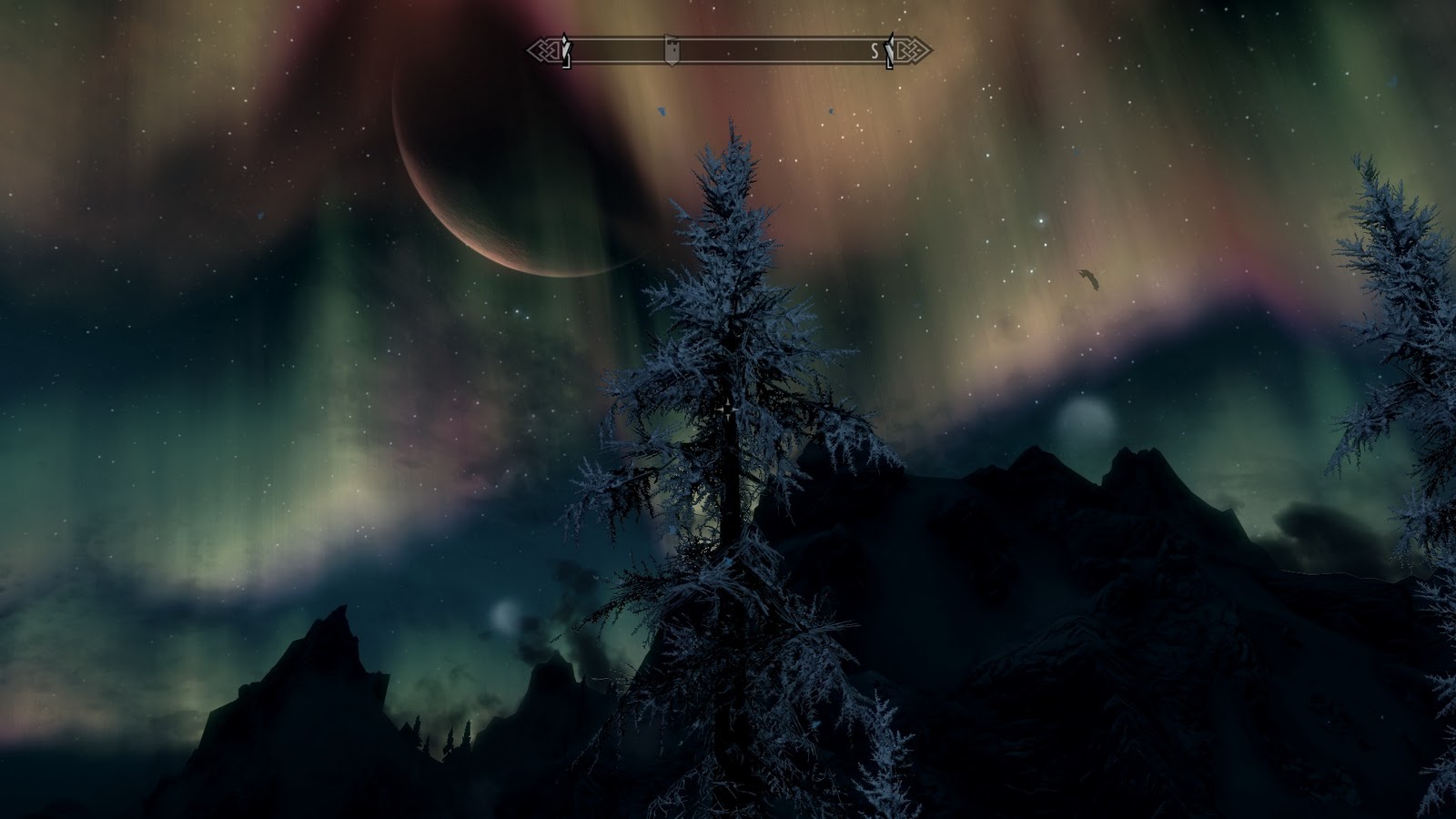
Aesthetically, the province of Skyrim is cold, blue-tinged, and harshly lit, like someone took a Jason Bourne movie on an arctic expedition. Hiking along icy rivers and up jagged mountains, I found the landscape to be dangerously beautiful—the kind of place that makes you want to let your guard down and enjoy the view, and then murders you with a savage pack of snow wolves. Just to give you an idea of how much of an impact these visuals had on me: whenever my character stepped out of the cold to sit by the fire of the nearest mead hall, in real life I actually felt warmer.

So pretty, I’ve almost forgotten about that polar bear that’s about to rip my head off.

From a purely technical perspective, however, the graphics of Skyrim certainly aren’t groundbreaking. Look too closely, and you’ll find plenty of sub-standard elements, like lackluster textures or rocks that appear to be made with only a handful of polygons. It’s a bit of a problem, and one that’s exacerbated on the Xbox 360 by the texture loading issues with hard-drive installations (for which there will apparently be a patch). Nevertheless, what Skyrim lacks in brute force, it makes up for in finesse.

Narrative: 4/5

The question of narrative is a difficult one for a game like Skyrim. A “story” is basically a distillation of reality with respect to a particular point of view. How do you tell a single story when you’ve created an entire world? In other words, a concept as limiting as “plot” is almost too small for Skyrim.

Oh, I see now... it says “dragon” right up there.
And here I thought I was fighting some other kind of giant, scaly, fire-breathing thing. 

Of course, there is an over-arching story line, which to be completely honest, I haven’t even finished yet (and it’s within the realm of possibility that I may not do so for the next 80 hours of gameplay). It seems reasonable enough, plodding along with some forgettable characters and mediocre voice acting. From what I have gleaned so far, it has something to do with dragons, which is really the only thing you need to know, because it means you get to have a blast killing some dragons.

For me, the meat of the game is really the ridiculous number of “side quests”, so much so that they should probably just be called “quests”. There’s an amazing number of things you can do, such as become a mercenary, join a secret brotherhood of assassins, go to college to be a mage, or fight in a rebellion against (or for) the Imperial army. From a narrative point of view, the only issue with all these choices is that a completionist like me will want to do them all, meaning that by the end of the game, your character ends up as some sort of ridiculous mercenary-assassin-wizard-rebel-type person, i.e. a schizophrenic.

Gameplay: 5/5

In Skyrim, gameplay has three main aspects: exploration, character development, and questing. Much of the game follows a basic yet rewarding formula: wander around until you find a dungeon, slay its inhabitants while you gain a level or two, and then rifle through the resulting mountain of corpses and steal anything of value. If you’re the sort of person who thinks that “fun” is spending a few hours wandering around hunting enough animals for pelts and picking enough herbs to make yourself a nice little leather cuirass and matching health potion, then Skyrim is for you.

Don’t be fooled. Just because those NPC’s look different, it doesn’t mean they aren’t all voiced by the same actor.

While Skyrim—like most Bethesda games—isn’t really about combat, there have been some definite improvements that make it much more palatable. The most notable is the ability to dual-wield. For instance, instead of a sword and a shield or a two-handed weapon, you could choose to fight with a sword and a fistful of fireballs, or by casting a different spell with each hand. When combined with the option to “favorite” certain items and spells in your inventory, the dual-wielding makes playing the game as a mage almost a reasonable option... almost.

Summary

If you’ve played and enjoyed Bethesda games before, then Skyrim shouldn’t disappoint. If you haven’t—but do fancy yourself an RPG fan—then Skyrim’s obvious improvements over past games make it an excellent place to start. Just be sure to bundle up, because it’s a bit nippy out there.