Showing posts with label First Person. Show all posts

Friday, November 23, 2012

Review: Halo 4

Although Halo 4 introduces great new enemies, weapons, and environments, 343 Industries ultimately plays it safe with this new chapter by skillfully iterating on the canonical Halo experience. 
One of the most disorienting experiences a critic can have is liking something, but not knowing why. In the context of video games it's an epistemological hazard I usually can avoid, but one series that persistently confounds my critical judgement is Halo.

For example, I've never found myself particularly inspired by Halo's militaristic, technology-driven, human-centric brand of science fiction; I instead prefer games like Mass Effect where you get to explore diverse cultural and sociopolitical relationships between advanced civilizations on a galactic scale, and also have sex with aliens. When it comes to competitive multiplayer, I usually opt for something like the deliberate, hyper-violent, highly strategic combat of Gears of War, which makes Halo and its floaty ragdoll physics look like NBA 2K13 by comparison. And in terms of protagonists, I pretty much prefer anybody to the Master Chief, a character so lacking in charisma he makes Gordon Freeman seem like George Clooney.

However, despite all my arguments to the contrary, I really do like Halo. Perhaps it's all those weapons, scattered around the battlefield with the abundance of dandelions in a glen. Perhaps it's the resulting frenzy of fast-paced combat, which resembles a firefight breaking out at the 2557 NRA national gun show. Perhaps its the panoply of bizarre vehicles, and the unfettered glee that accompanies soaring above the fray in a Banshee. Perhaps I just really like punching diminutive alien zealots in the face.

Given how poorly I comprehend my affection for the Halo series, it was with some concern that I approached this newest installment. Marking a return to the original storyline after a five year intermission, and serving as the first major development effort by the new stewards of the franchise, Halo 4 could have been the key to unlocking what I find so appealing about these ridiculous games, or it could have been enough of a misstep to finally break their spell over me.

Don't worry... even though the Chief has never seen this ancient alien weapon before, he won't let that fact keep him from killing stuff with it.

Perhaps unsurprisingly, Halo 4 achieved neither of these extremes. Instead, 343 Industries channeled their obvious devotion to the Xbox flagship franchise and delivered an incredibly faithful reproduction of the classic Halo experience. As far as a casual gamer like myself can tell, the fundamentals of the combat are essentially unchanged; other than a dedicated button for short sprinting and fact that the armor ability system of Halo: Reach has been retained, most of the time I felt like I could have been playing any game in the Halo library. (Incidentally, I was a big fan of the Reach ability system, and was psyched to see that the "hologram decoy" makes a triumphant return.) Halo 4 even takes pains to make sure the 10+ hours of single-player campaign include all the requisite gameplay hooks, from the frantic close-combat battles in nondescript futuristic space corridors to the epic clashes of heavy weapons platforms that are really difficult to steer properly.

Unfortunately, Halo 4's commitment to consistency means that a lot of opportunities for innovation are lost. For instance, even though an entire new civilization is introduced—and with it, a wealth of new enemies and technologies—the resulting gameplay changes remarkably little. The new Forerunner weapons reprise the same well-balanced collection of roles already filled by the existing UNSC and Covenant ordnance (e.g. assault rifle, battle rifle, sniper rifle, shotgun), and despite the few novel twists and tricks they throw at you, any new foes you encounter can usually be dispatched with the same old tactics.

Cortana is pretty much naked at all times, whereas John never even takes his helmet off. And that's the least odd thing about this couple.

I'm not really going to offer a critique of the plot of Halo 4, because frankly the entire mythology of the Halo universe confuses the hell out of me. Over the past 10 years I've managed to grasp that the Master Chief (a.k.a. SPARTAN-II commando John-117) is a biologically-engineered super-soldier whose girlfriend is an artificially intelligent computer program that was modeled after his mother and lives in his head. Also, they've saved the universe a few times. Beyond that I'm fairly lost, so if you're the sort of person who plays these games for the story and you've read this far, I've nothing more to offer than my apologies.

Although the campaign is certainly worth playing, as with past Halo games (and pretty much every other first-person shooter), folks are likely to spend most of their Halo 4 quality time in competitive multiplayer. After haranguing all my regular gaming buddies into dropping a bit of their precious pre-holiday cash on this particular title (as opposed to, say, Black Ops 2), I suppose I was relieved to find the multiplayer was as conservatively designed and incrementally innovated as the campaign. Of course, this means that while Halo 4 does well what Halo games typically do well (e.g. robust matchmaking and well-balanced competitive combat), it also does poorly what Halo games typically do poorly (right down to the clunky menus and the litany of arcane, ill-explained game modes). Then again, one of the multiplayer maps is a visually stunning remake of the Halo 3 favorite "Valhalla", so how much can one really complain?

Home of the gods.

Beyond competitive multiplayer, there's also been a general trend this console cycle towards more cooperative multiplayer game modes in shooters. In terms of quality, they typically range from paragons of game design like Gears of War's "Horde mode" to hokey half-assed pandering like Call of Duty's "zombie mode". Unfortunately, Halo 4's "Spartan Ops" cooperative game mode, which consists of episodic collections of co-op side missions, tends more towards the latter. Most missions are essentially glorified shooting galleries, and since you're free to respawn as much as you like, the primary challenge is how long you're willing to mop up the seemingly endless waves of enemies before you grow too bored to continue. If you're really looking to spend some quality time with your friends murdering aliens instead of one another, then playing the campaign in co-op mode is a much better bet.

In closing, I hate saying that Halo 4 is "basically another Halo game", but no matter how I run the numbers, that's the answer I keep coming up with. In other words, if the whole space marine thing has never really been your cup of tea, then Halo 4 is unlikely to be the game that changes your palate. However, if you're an old-school Halo fan looking to get back in the game or a current Reach regular looking to re-up your multiplayer, then Halo 4 is everything you need it to be, and maybe even a little bit more.

Friday, November 2, 2012

Review: Dishonored

Though it suffers from some of the common issues of first-person stealth games, Dishonored's rich world and engaging gameplay make it well worth your time.
I've always found extremely frustrating the style of gameplay typically engendered by stealth elements. In games like Metal Gear Solid or Assassin's Creed, no matter how hard I try, I find there's a huge gap between the player I want to be and the player I actually am. The player I want to be is a cunning, graceful, and deadly phantom who strikes fear into the hearts of his enemies. The player I am is the guy who accidentally alerts the first guard he encounters and then is forced to clumsily mass-murder everyone in the room.

For stealth to work well, a game needs to be designed with clear, reliable mechanics paired with intuitive systems for player feedback, which is why the XBLA title Mark of the Ninja released earlier this year was such a phenomenal game. These requirements are also why I find first-person 3-D stealth games like Thief and Deus Ex to be problematic—in this setting it's much harder to design good mechanics for visibility and to communicate when the player is hidden and what actions will cause them to be detected.

However, both Thief and Deus Ex are highly acclaimed works, because they create captivating worlds and then give us the breath of gameplay choices to interact with these worlds in a variety of interesting ways. Consequently, even though I suspected Dishonored might suffer many of the canonical pitfalls of first-person stealth games, I felt it only fair to give it the same chance to impress me with its world and the things I might do in it.

Let's start with a bit of background: Dishonored is set in the fictional city-state of Dunwall, a industrial-era Victorian sort of place where everything is powered by magical whale oil. Unfortunately, all this blubber-driven technology has little effect on a devastating plague that is decimating the city, and things quickly go from bad to worse when the Empress of Dunwall is murdered and you, her personal bodyguard and occasional boy-toy, are blamed for it. Shortly before your impending execution, standard video game tropes finally work their magic a grant you a means to escape, new weapons and gadgets, and supernatural powers, i.e. everything you need to go on a murderous campaign to seek revenge on the people that ruined your life and betrayed your country.

Dunwall is like the England of Charles Dickens crossed with the England of Children of Men.

I won't ruin the rest of the story except to say that there are a few plot twists, though I found them all to be fairly predictable. (And mind you, I'm the sort of person who rarely guesses plot twists beforehand.) However, what Dishonored lacks in story it more than compensates for in terms of ambiance and gameplay.

First, regarding ambiance: a lot of games do post-apocalyptic and pre-apocalyptic well, but rarely does one get a chance to enjoy straight-up apocalyptic. Dishonored does a great job of creating a city on the brink of total ruin, from the rat-infested slums to the lavish brothels and mansions where the aristocracy fortify themselves against the diseased masses. While other games might use such a setting as an opportunity for pointed social commentary, Dishonored seems content merely to use this world as a colorful backdrop for your personal quest for justice and revenge. This earnest portrayal, combined with well-written, superbly acted dialogue and a slightly stylized, hand-painted art style (think "disturbed Norman Rockwell"), make the world of Dishonored a very real and very fascinating place to inhabit.

After playing these kinds of games for a while, I find that I check my six a lot more often.

Second, regarding gameplay: as I'd originally feared, Dishonored makes a lot of missteps in their version of the traditional stealth mechanics. It's often difficult to tell at a glance if you're hidden or not, and the visual and audio cues that indicate an enemy has spotted you are subtle and easy to miss. More than a few times, while lying in wait to launch a devious attack on an unsuspecting guard, I was interrupted by being stabbed repeatedly in the back of the head by some guy I didn't even know was there. If you're trying to get through the missions clean, save frequently and be prepared to look at the loading screen a whole lot.

However, in many ways Dishonored is able to compensate for these issues by offering a diverse array of additional mechanics, allowing for the sort of player-choice-driven gameplay that made games like Thief and Deus Ex so successful. For example, imagine you're trying to infiltrate a particular building with the intent of sending one of your former colleagues into forced retirement. You might choose to use your mystical dark powers to (a) possess a rat and crawl in through a broken vent, (b) teleport to a second story ledge and sneak in through an open window, or (c) freeze time and then plant an exploding razor mine on the chest of the guard at the front door. Dishonored also takes great pains to extend this level of player choice to each mission as a whole. Each target has a number of ways they can be dispatched, from a simple knife to the face, to creatively engineered "accidents", to non-lethal (but often far more cruel) methods, which involve dropping the hammer of poetic justice on your adversaries by using the very things that made them powerful against them.

Here's an example of some guards "troubleshooting" a security barrier you've tampered with.

In fact, games elements like these "non-lethal" objectives are indicative of how Dishonored manages to still be successful without "solving the stealth problem". Even though I could have eschewed the temperamental stealth mechanics entirely and just cut a bloody swath through Dunwall head-on, the prospect of secretly getting my revenge without ever being seen or getting my hands dirty held a certain allure. (Also, there was the temptation of getting the "Ghost" achievement for not being detected or taking a life the entire game.) And for an imperceptive stealth-impaired klutz like myself, the fact that Dishonored managed to keep me happily skulking around rooftops for about 30 hours should be pretty high praise indeed.

Tuesday, October 9, 2012

Review: Borderlands 2

At times tightly designed and brilliantly executed, while at other times uninspired and juvenile, Borderlands 2 is an idiot savant of a first-person shooter.
On the lawless border world of Pandora, four "vault hunters"—a soldier, an assassin, a brute, and a powerful sorceress—are on a quest to find an legendary alien treasure. Guided by a mysterious artificial intelligence and assisted by a bizarre cast of supporting characters, these four brave adventurers battle feral creatures, psychotic bandits, and the forces of an evil corporation as they search for the mythical Eridian Vault and its promise of immeasurable wealth and power.

This little tale was the premise of the original Borderlands, and having sunk a lot of time into the first game, it is a story with which I am quite familiar. Consequently, I was somewhat disappointed when I realized a few minutes into the introduction of Borderlands 2 that this was also the premise of the sequel.

However, after spending a lot more time with the second game, I realized how wrong I was. Borderlands 2 isn't really about vault hunters, nor is it about "Handsome Jack" (the game's narcissistic, sociopathic, endlessly chatty villain), nor is it a commentary on imperialism and corporate greed, nor is it about murdering lots of dudes to snag color-coded loot. (Well, maybe it's a little bit about that last thing.) Rather, Borderlands 2 is about expectations, and why you should put yours aside when you play this game. It's also about an inbred chubby-chasing mechanic named Scooter.

I'm convinced that understanding this man is the secret to understanding Borderlands.

Like the original, Borderlands 2 is a self-styled "role-playing shooter" (RPS), combining the gameplay of a first-person shooter with the kinds of leveling systems, random weapon drops, and quest structures more traditionally found in role-playing games. Throughout the game's fairly linear mission structure ("go to point A, kill thing B, repeat") you'll encounter a variety of bizarre characters, such as an unbelievably annoying and foul-mouthed tween of a demolitions expert, a cyborg anthropologist who comes across more or less like a black Rudyard Kipling (how's that for irony?), and the four vault hunters from the original Borderlands (formerly a bland collection of nearly mute player characters, now somehow infused with distinct personalities).

However, the character I found most intriguing was Scooter, who reprises his role as the redneck proprietor of the "Catch-A-Ride" vehicle creation system. Scooter is friendly, talkative, funny, secretly romantic, and likely quite inbred, which is unsurprising given the occasional allusions to his incestuous urges. Despite his affable nature, he's got a casual murder or two under his belt, indicating that he's achieved the same level of moral flexibility exhibited by everyone else on this brutal wasteland of a planet. Also, he's a savant when it comes to engineering, and he seems to be one of the only people around capable of dealing with Pandora's incredibly advanced technology. In short, Scooter is Borderlands 2: an uninspired, frequently predictable stereotype full of crass behavior and juvenile dialogue, but one that also exhibits flashes of true technical genius, genuinely funny comedy, and uncharacteristic emotional depth.

Borderlands 2 may be the smartest dumb game I've ever played.

All of this brings me back to my original point about expectations. It would be easy to say that Borderlands 2 is simply "more Borderlands", because on a certain level that's the truth. It would be similarly easy to view it as yet another first-person game with RPG elements (à la Mass Effect, Bioshock, Fallout, or Deus Ex), with a repetitive mission structure and too much hand-holding. Likewise, it would be perfectly reasonable to take in the game's gratuitous violence, meet its over-the-top characters, and listen to their many jokes that fall flat more often than not, and then find yourself turned off by a title that seems like it is simply trying too hard.

A better approach, though, is to put your expectations aside and leave yourself open to the true moments of brilliance that can be found in Borderlands 2. It can be found in the expertly balanced combat, the amazing diversity of weapons (with their impressive array of custom reloading and firing animations), or among the many subtle improvements Gearbox has made to the enemy AI. It can be seen in the franchise's unique "concept art" graphical style, which feels more lovingly hand-drawn yet stylishly hyper-real than ever. It can be found in a ninja assassin who speaks only in haikus and emoticons (which is who I played most of the game as), and in a villain who turns out to be a much more complicated brand of douchebag than he originally seems. And of course, sometimes that brilliance can come from a porn-addicted hillbilly mechanic and amateur poet named Scooter, who helped me save the world of Pandora while making me laugh out loud more than once.

Wednesday, November 16, 2011

Review: The Elder Scrolls V: Skyrim


For anyone addicted to release-date gaming, this November has been a grueling month, each week stuffed to bursting with high-profile new games. It’s been the kind of hectic month that April is for certified public accountants, though probably with a lot more software patches. 

This week, we’ll be running the numbers on Skyrim, the fifth and latest installment in Bethesda Softworks’ flagship role-playing franchise The Elder Scrolls. (Note that this is the last time I will use the word “scrolls”, because like Notch (the indie developer behind Minecraft—I don’t feel it particularly embodies the spirit of the series. Plus I’m afraid of getting sued.)

Design: 5/5

If you’ve never played Bethesda games (such as Morrowind, Oblivion, Fallout 3, or New Vegas) before, they’re best summed up by one word: MASSIVE. Starting a Bethesda game is like reliving your own birth: after a short tutorial in a safe, warm dungeon, you are expelled into an enormous and confusing world full of hostile beings, most of whom are trying to kill you. Like its predecessor Oblivion, the game world of Skyrim spans about 16 square miles to scale (approximately two-thirds the size of Manhattan) and has around 150 dungeons, nearly all of which are completely accessible from the moment you step out of your little instructional womb. While environments this expansive are impressive for any role-playing game, they come across as even more amazing when presented in this unfettered open-world style.

In Skyrim, the shortest distance between two points almost always involves a mountain.

The down side of a game this enormous is that technical glitches are almost a certainty. Like past Bethesda games, Skyrim has its fair share of bugs, though in my experience they’ve been of stereotypical and fairly harmless varieties, such as occasional missing textures, erratic AI behavior, and one or two “outside the map” glitches. I found they had little impact on my gameplay—especially for a compulsive game-saver such as myself—and so far I’m inclined (as with other Bethesda games) to overlook them.

What really impresses me about the design of Skyrim are those few minor changes made from Oblivion that have had an enormous impact, such as improvements to the leveling system. In Oblivion, your character gained a level whenever he/she had sufficiently advanced specific favorite skills. However, the improvements to your statistics (e.g. strength or dexterity) depended on how much you had improved those and other skills. For example, let’s say you were a heavily armored, warhammer-wielding orc. If you wanted to make sure that by level 40 you were at least as dexterous as your average severe stroke victim, you couldn’t just work on increasing your “speed” attribute as part of normal gameplay. Instead, you had to go off and pick 100 locks or spend 15 minutes swimming in circles whenever you were about to advance to your next level. In Skyrim, on the other hand, most of your attributes are derived from your skills. If you start off as a mage but decide later to dabble in a little swordsmanship, it won’t take much practice before your spindly, atrophied arms are swinging that broadsword like a pro. It’s a subtle difference that has a huge effect on the gameplay.

Artistic: 4/5

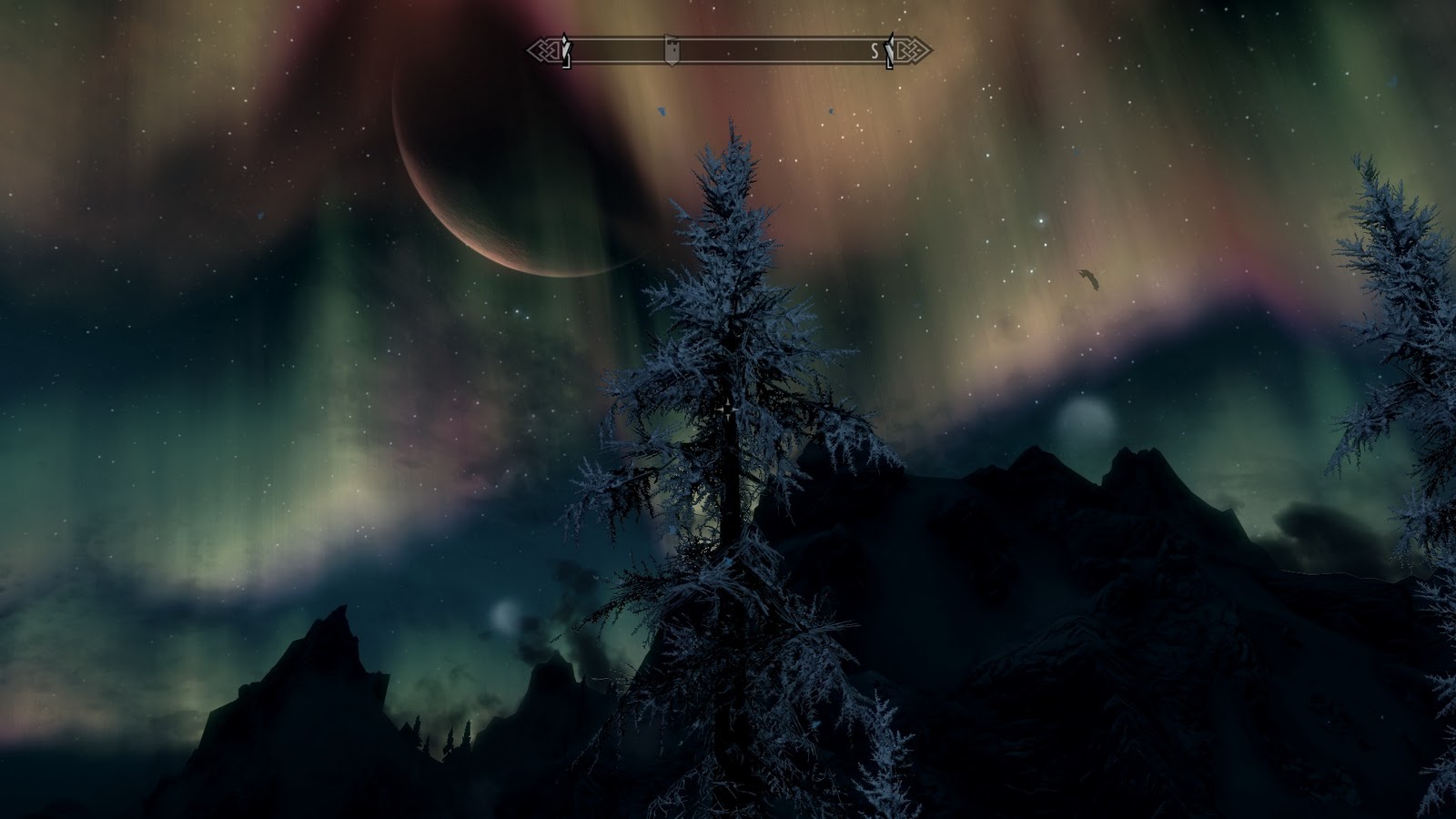
Aesthetically, the province of Skyrim is cold, blue-tinged, and harshly lit, like someone took a Jason Bourne movie on an arctic expedition. Hiking along icy rivers and up jagged mountains, I found the landscape to be dangerously beautiful—the kind of place that makes you want to let your guard down and enjoy the view, and then murders you with a savage pack of snow wolves. Just to give you an idea of how much of an impact these visuals had on me: whenever my character stepped out of the cold to sit by the fire of the nearest mead hall, in real life I actually felt warmer.

So pretty, I’ve almost forgotten about that polar bear that’s about to rip my head off.

From a purely technical perspective, however, the graphics of Skyrim certainly aren’t groundbreaking. Look too closely, and you’ll find plenty of sub-standard elements, like lackluster textures or rocks that appear to be made with only a handful of polygons. It’s a bit of a problem, and one that’s exacerbated on the Xbox 360 by the texture loading issues with hard-drive installations (for which there will apparently be a patch). Nevertheless, what Skyrim lacks in brute force, it makes up for in finesse.

Narrative: 4/5

The question of narrative is a difficult one for a game like Skyrim. A “story” is basically a distillation of reality with respect to a particular point of view. How do you tell a single story when you’ve created an entire world? In other words, a concept as limiting as “plot” is almost too small for Skyrim.

Oh, I see now... it says “dragon” right up there.
And here I thought I was fighting some other kind of giant, scaly, fire-breathing thing. 

Of course, there is an over-arching story line, which to be completely honest, I haven’t even finished yet (and it’s within the realm of possibility that I may not do so for the next 80 hours of gameplay). It seems reasonable enough, plodding along with some forgettable characters and mediocre voice acting. From what I have gleaned so far, it has something to do with dragons, which is really the only thing you need to know, because it means you get to have a blast killing some dragons.

For me, the meat of the game is really the ridiculous number of “side quests”, so much so that they should probably just be called “quests”. There’s an amazing number of things you can do, such as become a mercenary, join a secret brotherhood of assassins, go to college to be a mage, or fight in a rebellion against (or for) the Imperial army. From a narrative point of view, the only issue with all these choices is that a completionist like me will want to do them all, meaning that by the end of the game, your character ends up as some sort of ridiculous mercenary-assassin-wizard-rebel-type person, i.e. a schizophrenic.

Gameplay: 5/5

In Skyrim, gameplay has three main aspects: exploration, character development, and questing. Much of the game follows a basic yet rewarding formula: wander around until you find a dungeon, slay its inhabitants while you gain a level or two, and then rifle through the resulting mountain of corpses and steal anything of value. If you’re the sort of person who thinks that “fun” is spending a few hours wandering around hunting enough animals for pelts and picking enough herbs to make yourself a nice little leather cuirass and matching health potion, then Skyrim is for you.

Don’t be fooled. Just because those NPC’s look different, it doesn’t mean they aren’t all voiced by the same actor.

While Skyrim—like most Bethesda games—isn’t really about combat, there have been some definite improvements that make it much more palatable. The most notable is the ability to dual-wield. For instance, instead of a sword and a shield or a two-handed weapon, you could choose to fight with a sword and a fistful of fireballs, or by casting a different spell with each hand. When combined with the option to “favorite” certain items and spells in your inventory, the dual-wielding makes playing the game as a mage almost a reasonable option... almost.

Summary

If you’ve played and enjoyed Bethesda games before, then Skyrim shouldn’t disappoint. If you haven’t—but do fancy yourself an RPG fan—then Skyrim’s obvious improvements over past games make it an excellent place to start. Just be sure to bundle up, because it’s a bit nippy out there.

Monday, November 7, 2011

Review: Deus Ex: Human Revolution

Deus Ex: Human Revolution is the third and latest entry in the Deus Ex franchise, a series of first-person action role-playing games set in a dystopian future full of sunglass-wearing cyborgs. For those of you new to the series, here’s a helpful little timeline:

2000. The original Deus Ex comes out, giving PC gamers and cyberpunk fans an innovative new gaming experience, which keeps them occupied while people with actual lives are off drinking Budweiser and dancing to Thong Song by Sisqó.

2011 (The Present). I play Deus Ex: Human Revolution for the Xbox 360, subsequently composing this scintillating review.

2027 (16 years in the future). The events of Human Revolution take place. Not only has the advent of cybernetic technology blurred the lines between man and machine, it also has somehow led to everyone keeping their important belongings (i.e. money, booze, and weapons) in unlocked drawers, sewer drains, and easily accessible man-sized air vents.

2052 (another 25 years after that). The events of the original Deus Ex take place. Everyone notices that in the past 25 years, the world’s graphics just don’t seem as good, and the selection of available cybernetic augmentations has somehow gotten markedly less awesome. However, Deus Ex fanboys argue that everything is better than whatever happened 25 years ago.

Design: 3 / 5

For the most part, Human Revolution tries to recapture the spirit of the original Deus Ex. The core philosophy of both games is that a truly immersive gaming experience should support a variety of play styles.

Presenting Adam Jensen, your protagonist.
I’d say he’s half man and half machine, but it’s really more like 3/4 machine, 1/8 gravely voice, and 1/8 sunglasses.

Let’s say it’s your goal to get inside a particular locked room. In Deus Ex, you can choose to tackle this challenge via any one of the following approaches:
  1. Kill the guard and hack the electronic door lock.
  2. Knock out the guard, draw a penis on his forehead in permanent marker, and then search his unconscious body for the door code.
  3. Chat up the guard with a little “Hey, how ’bout that whole ‘guarding things’ thing... sucks, am I right?” and then convince him to let you in.
  4. Climb through an air vent in the next room and use your bad-ass robotic arms to punch through the adjoining wall.
  5. Do #4 above, but then kill the guard on your way out for good measure.
The extent to which you will be successful in any one of these approaches depends on your character’s particular set of abilities. Using software upgrades called “Praxis Kits”, you can unlock different cybernetic abilities (or “augments”) that let you excel in different styles of game play. For example, one ability allows you to sneak around more quietly, while another lets you release pheromones that make you more persuasive. There’s also one that instantly vaporizes any nearby life form into a bloody mist by way of a lethal cloud of high-speed metal bearings. Although very cool, this one is somewhat less useful than the pheromones when Adam Jensen is on a date.

Just because you made a pretty loading screen doesn’t mean I want to stare at it for 60 seconds every time I fuck up.

Considering how many ways you can approach nearly every aspect in the game, the developers did a decent job keeping the game balanced and relatively bug-free. I tried a few different character builds, and they all were fun and playable. I had heard that the boss fights were a little unforgiving toward non-combat play styles, but even when playing with a non-lethal stealth character, I didn’t find them to be out-of-step with the difficulty of the rest of the game.

I did have a few issues with the game design, however. First, the control scheme isn’t the best around, and routine things like readying/equipping weapons and using items were a lot more cumbersome than they need to be. This wasn’t too much of a problem for the pacifist ninja I played most of the game as, but I could see it being quite frustrating for a combat build. A much bigger issue was that the load times were frustratingly long. I don’t know if I’ve just been spoiled by the seamless loading strategies of other games, but by the end of Human Revolution, I was literally choosing my course of action based on what was the least likely to return me to that damned loading screen.

Artistic: 4 / 5

For the most part, there’s not much about the aesthetics of Human Revolution that will knock your socks off.  There’s only so many ways you can can rip off Blade Runner, and with light-up umbrellas off the table, options are somewhat limited.

The streets of modern Hengsha. It reminds me of the old saying: “Visions of a dystopian future are like assholes: everyone has one, and they’re usually dark, brown, and full of toxic pollution.”

However, the game does manage to put a few of its own small twists on a tired genre. While most of today’s companies would have us believe that our future will be full of smooth, elegant curves like one big iMac in an evening dress, the world of Human Revolution is decidedly angular. Triangles appear to be the most fashionable shape one can wear, and most of the buildings and vehicles could have been designed by Volvo. Even Jensen’s chin is aggressively pointed, like his goatee is coming to attack you. It’s a solid motif, and helps convince me that some genuine thought went into the art design of the game.

Yelena Fedorova: voted worst-dressed villain of 2027.

Narrative: 4 / 5

If you can suspend enough belief to get past its idiosyncrasies, the world of Human Revolution can be quite enthralling. Although Jensen has the charisma of Keanu Reeves pretending to be a paperweight, his story is set against the backdrop of an ideological clash between the corporations that want to further the goal of human augmentation and factions that wish to resist and/or eradicate it. Throughout the missions, I was exposed to a number of opinions on both sides of this massive societal struggle, and I found it to be an interesting and believable setting for the events of the game.

Honestly, the thing that kept pulling me out of the game is what I call the “douche factor”. Since Jensen is a cold, monotone, and fairly unlikable character, it seemed like the game designers tried to force me to empathize with him using a simple strategy: making everyone else in the game more unlikeable. Sure, Jensen may seem like kind of a hard-ass, but wait until you meet Frank Pritchard, the douchey IT guy at his company, or David Sarif, his douchey boss. Compared to these pricks, Jensen seems like a swell guy. In fact, pretty much everyone you’ll meet in this game is kind of a jerk, which might explain why so many people are trying to kill you.

Gameplay: 4 / 5

If I had to sum up Human Revolution with one word, it would be choice. I’m not talking about the bullshit moral choices of games like Mass EffectFable, or inFamous, where you basically have to decide at the beginning of the game if you’re going to play as a bloodthirsty sociopath or a benevolent doormat, depending on which path gets you the coolest stuff. I’m talking about playing the game as though you’re a real person. Perhaps you’re the type of guy who tries not to kill people, unless it’s really convenient. On the other hand, maybe you like to put as many bullets in bodies as possible, but decide to talk your way past a guard just that once. In other words, instead of your character being a one-dimensional caricature of a moral being, Human Revolution (like its predecessor) allows you to approach each situation individually, weighing strategic concerns, moral issues, and your own personal preferences to determine your way through each challenge.


This whole computer hacking thing seems a bit unnecessary, considering this guy probably wrote out his password on a Post-It and left it next to his keyboard. 

Unfortunately, if this whole choice thing doesn’t sound that interesting to you, then I have to tell you that a lot of the other gameplay elements are lacking. By combining elements of a shooter, a stealth action game, and a role-playing game, Human Revolution is jack-of-all-trades and master of none. If you’re looking to experience high quality gaming in any of these other genres, you’ll find better experiences elsewhere.

Summary

Without a doubt, the original Deus Ex was a landmark experience that brought something new to the world of gaming, and as its heir, Human Revolution goes a long way at recapturing the spirit of the original. While it has some quirks, and may annoy the hell out of you at times, Human Revolution is still worth checking out, especially for those of you who are new to the world of Deus Ex. Now, it’s time for me to go... I think my save game is almost done loading.

Friday, February 25, 2011

Review: Bulletstorm

In the supper of video gaming, first-person shooters are the red meat: bloody, delicious, and unlikely to be dethroned as our dominant form of sustenance, no matter how many heart attacks they cause. Our latest helping of hamburger is Bulletstorm, an FPS from People Can Fly (makers of Painkiller) and Epic Games (of Gears of War fame). Following the adventures of Grayson Hunt—a former military assassin turned space pirate and part-time Christian Slater impersonator—Bulletstorm invites you the abandoned resort city of Elysium, where you get to carve a brutal, limb-strewn swath through waves of mutants as you “kill with skill”.

Friday, December 10, 2010

Review: Call of Duty: Black Ops

Call of Duty: Black Ops is the seventh installment in the Call of Duty series.  Set this time in the 1960’s, it shows that the only thing with more longevity than the Call of Duty franchise itself is American nostalgia for the Cold War. I’d say things have gotten pretty bad when game developers start to think, “You know what people might enjoy fighting again? The Vietnam War.”

Like the Call of Duty: Modern Warfare 2 single-player campaign, you play as a variety of characters, though most of the action centers around Studies and Observation Group (SOG) operator Alex Mason. During the campaign, you attempt to uncover a Russian plot to... ah, who are we kidding? Anyone who plays this game either (1) got it for the multiplayer, or (2) accidentally purchased it because they got it confused with a Splinter Cell game.

Wednesday, December 1, 2010

Shooting Up

I recently jumped on the Call of Duty: Black Ops bandwagon. (Or maybe just I fell off of the “I’m too cool to play the new CoD game” bandwagon—either way, I’m certain there was a wagon involved.) Regardless, the irony of this choice is threefold, because that’s as many fold as I feel like discussing right now.

I prefer to take the coward's way out, but I usually get executed first.
Irony the First: I typically avoid first-person shooters, largely because I’m not very good at them. I feel like there was some special gym class in high school or something where they taught everyone how to be good at shooters, and I happened to be absent that day. (I was probably pretending to be sick so I could play Final Fantasy II.) Sometimes in multiplayer my opponents don’t even shoot at me; they just point and laugh. In past years, however, games like Half-Life and Bioshock have worked to subvert my disdain by exploiting my love of RPG’s and trying to win me over with their amazing characters, environments, and story arcs. Slowly but surely, these games have paved the way for me toward more typical FPS’s.

Irony the Second: whenever my ego is feeling robust enough that I’m willing to subject myself to an FPS, I usually tend towards ones with more of a sci-fi flare. To me, games like Call of Duty seem like little more than the following: choose one from a collection of nearly identical guns, and then use it to murder a bunch of nearly identical guys in a series of nearly identical environments. I prefer the greater variety offered by games like Halo (where you fight against an invading alien force called the Covenant, which is trying to wipe out all of mankind), or Half-Life (where you fight against an invading alien force called the Combine, which is trying to wipe out all of mankind), or Gears of War (where you fight against an invading alien force called the Locusts... okay, so maybe the variety argument isn’t a good one).

Irony the Third: I only just got Call of Duty: Modern Warfare 2 a few weeks ago, despite repeatedly telling my friends I wasn’t really interested. I actually only got the game because a friend of mine saw it in a used games store in Virginia and mailed it to me. Now, instead of not playing MW2 with them because I don’t own it, I’m not playing MW2 with them because I’ve moved on to Black Ops. What an asshole.

Anyways, I have to admit that the Black Ops multiplayer is addictive enough that I foresee myself playing it for quite some time. Maybe with enough practice I can graduate from “guy who gets knifed in the back while running around like a jackass” to “guy who gets knifed in the back while hiding in the corner trying to drive a stupid exploding RC car”.