Showing posts with label Reviews. Show all posts

Monday, April 1, 2013

Review: BioShock Infinite (Xbox 360)

BioShock Infinite does what the BioShock series does best, weaving a thrilling narrative into a rich and captivating world.
Like any medium for artistic expression, video games can allow us to experience fantastic new worlds that entertain and inspire us. Unlike most other mediums, though, games also allow us to interact with those worlds. This characteristic begets an enormous challenge when creating a video game; while a novel or a film has to create a world that is convincing when experienced through the controlled environment of the page or the screen, a video game has to create one that is convincing when you walk around inside of it and poke things, often in an effort to wreck the joint.

In the pantheon of video games, one title stands above all others in terms of creating a truly fascinating and compelling world: the original BioShock. The undersea city of Rapture is one of the most vivid locations I've ever visited in a game, and while some worlds have been bigger or more detailed or rendered with more polygons, none have ever felt as real. In fact, the place that comes the closest is the floating city of Columbia, the setting of the new BioShock Infinite.

Tuesday, March 26, 2013

Review: Gears of War: Judgment (Xbox 360)

Though a little on the lean side in terms of content, Gears of War: Judgment is pretty good... provided you like third-person Halo games.
Shooters are the video-game equivalent of jazz music. To some people they seem like so much chaos and noise, and many have trouble discerning the subtleties that distinguish one work from another. Through practiced appreciation, though, the connoisseur learns to identify tightly woven patterns of structure and balance, a framework that allows seemingly minor creative changes to have a massive impact on the mood and feel of the piece. This dichotomy of chaos and order is why two games like Halo and Call of Duty can seem like interchangeable murder simulators to the layperson, whilst the expert experiences them as differently as one would a Thai massage and a colonoscopy.

The narrow chasms that differentiate shooters are especially relevant when we consider franchises and sequels. For example, the Gears of War series sets itself apart with combat that is far more deliberate and strategic than that of "twitchier" shooters like Call of Duty, while still achieving the kind of high-octane arcade flair not present in tactical shooters like Rainbow Six. However, when designing a new entry for an established franchise, developers face a dilemma: how can the game evolve, without changing so much that it becomes an entirely different kind of shooter?

Tuesday, March 5, 2013

Review: DmC: Devil May Cry (Xbox 360)

Ninja Theory's inspired reboot doesn't just revive Capcom's aging hack-and-slash franchise, it transforms it.
In 1893, after writing twenty-four short stories and two books chronicling the life and times of Sherlock Holmes, Sir Arthur Conan Doyle penned the final chapter on the world's greatest fictional detective. However, after enduring ten years of hate mail from irate Victorian-era Sherlock fanboys, Doyle revived his legendary character in what may have been the first act of retconning in modern literary fiction.

In the 120 years since, we've witnessed every perversion a fiction series possibly can endure: sequel upon sequel, retcons, reboots, remixes, parallel timelines, extra-canon works, and the occasional musical episode. Sometimes these machinations are blatant cash-grabs, attempts to wring a few extra dollars out of an aging franchise. Other times they're more like an intervention, a frantic attempt to salvage a treasured intellectual property that's careening horribly off-course. Every once in a while though, they're a truly visionary contribution, one that unlocks potential in the source material you never suspected was there.

DmC: Devil May Cry—Ninja Theory's reboot of Capcom's Devil May Cry series of hack-and-slash action games—is a prime example of this third type of work. The original Devil May Cry for the PlayStation 2 was conceived by Hideki Kamiya (whose other credits include Resident Evil, Viewtiful Joe, and Bayonetta), and introduced the series' protagonist Dante, a half-demon mercenary with an enormous ego and an ever bigger grudge against the forces of Hell. Despite its poorly-translated dialogue and nonsensical plot, the first Devil May Cry was one fun game to play, largely because of its incredibly fluid, highly stylized combat, which inspired games like God of War and Castlevania: Lords of Shadow.

Dante v2.0.

I've never found the lore of Devil May Cry to be overwhelmingly compelling, and thus I was hardly disappointed when the second, third, and fourth installments of the series failed to improve upon the mediocre storytelling of the first. Although I was pleased with each game's incremental refinements in play control, combat mechanics, and graphics, I certainly felt no great excitement at the prospect of a full series reboot. Since I couldn't even really describe what happened in the first four games, why in the world would I care if someone wiped the slate clean and started anew?

Boy, did I underestimate the developers at Ninja Theory though, because they did something I never though was possible. They took Dante, cocky, rebellious attitude and all, and reshaped him and his universe a way that finally made sense.

"The Hunter" is an evil, foul-mouthed bounty hunter and your first boss encounter. In terms of geniality and physical attractiveness, later bosses will make this guy look like a Disney princess by comparison.

Perhaps things will be clearer if we compare and contrast the old and new Devil May Cry. The original Dante (circa 2001) tried to be cool in that whole pre-millineal Matrix leather-trenchcoat-and-backflips sort of way, while exploring a stereotypically gothic island castle and slaughtering his way through waves of demonic marionettes. His nemesis was the Demon King Mundus, who possessed few if any characteristics to distinguish himself from the innumerable other incarnations of the Devil throughout history.

Dante v2.0, though, is pure punk revival. He talks, dresses, and behaves like a man who doesn't give a shit, because at the beginning of the game he really doesn't. His reimagined nemesis is Kyle Ryder, a skeevy business magnate who serves as Mundus's vessel in the human world. His gothic castle is a skyscraper, and instead of controlling humanity through hordes of demons, he controls them through electronic surveillance, tainted soft drinks, and round-the-clock propaganda from DmC's parody version of the Fox News Network.

Nearly all of the action takes place in Limbo, a warped reflection of the human world where even the walls and floors are trying to kill you.

This take on the world of Devil May Cry creates a brash new context for Dante's epic struggle that never existed in the previous games. When Dante dismembers scores of demons, it's not only because Mundus destroyed his family, but also because fuck them, that's why. When he vents his anti-establishment attitude, it's because there actually is an establishment, and it's enslaved an entire realm of humanity.

What really makes the new DmC so remarkable, though, is the way these narrative themes are woven throughout the entire design and aesthetic of the game, creating a visually, aurally, and kinesthetically cohesive experience. For example, Dante not only looks like one of the Sex Pistols, but even his fighting style is a little impetuous and self-destructive, with combos that include the occasional bits of flourish and exaggerated, off-balance swings. Mundus, on the other hand, imposes his will through furious edicts rendered in giant Helvetica text, his very words distorting reality into the twisted shadow forms of the demon world. This contrast—the fluid freedom of Dante opposing the crushing, wrathful order of Mundus—makes the world of DmC a thrill to inhabit.

Mundus the Giant Has a Posse... OBEY.

Even placing all of these stylistic accoutrements aside, DmC is still at its core a great action game. The combat is as tight as it has ever been, with a great variety of weapons and multiple combat styles. While no single battle mechanic is particularly groundbreaking (in fact, many of the legacy combos are carried over directly from previous games), the ability to switch quickly between standard, area-of-effect, and directed heavy attacks encourages fast-paced and innovative gameplay. A particularly interesting addition is the "Ophion Whip", a tether that can be used to pull enemies to Dante (or vice versa) as well as for traversal; it can also disarm certain enemies and perform other special actions via quick-time events. In this manner, the Ophion Whip allows Dante to operate in environments with a massive sense of scale, while also granting him the speed, flexibility, and total battlefield control this style of game demands.

As I'm nearing the end of this review, I realize there's so many other great things about this game that I have yet to mention. There's Vergil, Dante's twin who is as stunningly rendered and painstakingly characterized as is his brother. There's Bob Barbas, the news network talking head whose boss fight is one of the best and most innovative I've ever seen, anywhere. And there's all the thoughtful little design elements, like the fact that the pause menu informs you how long it's been since your last checkpoint, or that you can hop to a training screen to practice your combos from practically anywhere. I suppose I don't need to go on, though, as my opinion by this point should be clear: if DmC isn't the perfect game, then it's pretty damn close.

Tuesday, February 5, 2013

Review: The Cave (XBLA)

Though it's a clever and enjoyable enough way to spend a few hours, The Cave is unlikely to impress anyone who knows how great Ron Gilbert's games can really be.
In 1987, the debut works of two great artists were released: Guns N' Roses' Appetite for Destruction and Ron Gilbert's Maniac Mansion. Each was a landmark contribution it its respective field, a herald of great changes yet to come. While their contemporaries were concerning themselves with trivialities like stomping adorable Japanese mushrooms and pouring some sugar on things, Ron Gilbert and Guns N' Roses were visionaries alike, breaking new ground whilst addressing raw and edgy concepts like heroin addiction and sentient disembodied alien tentacles.

During the subsequent five years or so, Guns N' Roses would release legendary rock epics like "November Rain" and "Civil War", while Ron Gilbert would create The Secret of Monkey Island and Day of the Tentacle, which are essentially the point-n-click adventure game equivalents of legendary rock epics. After that, the members of GnR and Gilbert would do what all great artists seem to do these days: hang around for another two decades occasionally producing works that will never hold a candle to their previous masterpieces, but that I—like all the other nostalgia addicts out there—buy anyways.

Gilbert's newest work, The Cave, is a downloadable title available on PC, OS X, the PS3 Network and Xbox LIVE Marketplace. A puzzle adventure game vaguely reminiscent of his original Maniac Mansion, The Cave lets you choose three out of seven playable characters with whom to explore a surreal, hostile environment, solving puzzles with found items while unlocking the secrets of a mysterious world. (For some reason there's also a platforming component, presumably to meet some sort of genre diversity quota imposed by our liberal activist government.) The cast is a predictably diverse set of zany characters, such as a a time-traveling museum worker and a pair of possessed twin children. Each has their own special ability that alters the way you solve puzzles in "The Cave" (such as the ability to bypass locked doors or to hold one's breath), and each has a dark motivation for pursuing the wealth and power hidden in its depths.

Welcome to "The Cave".

Despite having been underwhelmed by Gilbert's recent Deathspank games, I approached The Cave with uncharacteristic amount of optimism, in part because it was a collaboration with one of my favorite studios, Tim Schafer's Double Fine Productions. Unfortunately, I've found in my life that such incidents of optimism rarely go unpunished, and this time was no exception. Even though Gilbert's Maniac Mansion pioneered the multi-character puzzle adventure, the past 25 years have seen amazing innovations on the original concept (see the classic SNES game The Lost Vikings, or last year's PC title Resonance), and The Cave feels a bit behind the times by comparison. Most of the features that set it apart from similar games feel like concessions instead of improvements, such as the fact that your characters can only carry one item at a time, or that the platforming elements are as tedious as they are unnecessary.

I'm certainly not asking Gilbert to retread old ground, but The Cave could go much further in building on the essence of what made games like Monkey Island great. For me, the magic of these games was that moment when the moving parts of a puzzle clicked into place, when your brain twisted in just the right way and you could suddenly see the perverse logic that governed these fantastical, comical worlds. There's times when The Cave dabbles in these mind-bending realms—for instance, when a guard slips because you placed a "wet floor" sign in front of him—but for the most part, the puzzles are of the fairly straightforward "lock-and-key" variety. Even the multi-character component is only delivered by half-measures, as most areas are either generic enough to be traversed nearly identically regardless of your team, or they're so particular to a single character that the other two are irrelevant.

Fun fact: advertising revenues from grog companies have funded nearly all of Ron Gilbert's games.

In the end, though, I found the biggest barrier to enjoying The Cave wasn't the mediocre gameplay, but rather the setting itself. I've always had a limited affection for places like Alice's Wonderland, fantasy settings where literally anything can happen... because if anything can happen, then essentially nothing can happen. In such lands of sheer absurdity, nothing is of consequence, nothing is surprising, and this utter lack of terra firma means there's no foundation upon which to build a compelling narrative. In other words, Gilbert's particular brand of charm shines much better in a place where the rules are ludicrous—like the Edison family mansion or Melee Island—than in a place with no rules at all.

Thursday, December 6, 2012

Review: Assassin's Creed III

Incoherent gameplay, bizarre design choices, and frequent bugs squander much of the potential of this visually and thematically stunning game. Disappointment, thy name is Assassin's Creed III.
Disappointment is a peculiar emotion. I can be angry without first having felt calm, and I can feel happy without first having felt sad, but to be disappointed, I really need to have experienced something else first, usually "optimism". It is this characteristic that makes disappointment the most insidious form of emotional malaise: we are exposed to it entirely of our own volition, by first allowing ourselves to hope.

My friends, readers of my blog, and even strangers with whom I've made accidental eye contact know how uncontrollably optimistic I've been about Assassin's Creed III, beginning with the moment I first saw the leaked box art. It was then that I learned the fifth major installment in Ubisoft's epic action-adventure franchise would take place during the American Revolution, that it would feature a bad-ass tomahawk-wielding Native American, and that it would likely allow me the unique opportunity to scamper around the rooftops of a colonial-era replica of my hometown city of Boston, using British Redcoats as foul-mouthed, tea-swilling archery targets.

However, the clever reader will have inferred from my earlier ramblings concerning "disappointment" that this optimism was... misplaced. So what went wrong? How did Assassin's Creed III make the transition from my Most Anticipated Game of 2012 to Biggest Letdown?

Assassin's Creed III is beautiful, but unfortunately looks aren't everything.

Let's start with the basics. Assassin's Creed III draws its foundation from the other games in the series, relying heavily on their well-established portfolio of game mechanics. As you step back into the Animus to re-live the adventures of yet another historical Assassin (this time it's Ratonhnhaké:ton, a.k.a. "Connor", Desmond's Revolutionary-War-era ancestor), you'll quickly find yourself climbing, sneaking, and murdering again like old times. In fact, you'll feel almost as though you were playing any other Assassin's Creed game... but unfortunately, the key word here is "almost". In its attempts to build upon the franchise's winning formula, Assassin's Creed III somehow manages to struggle with narrative and design elements that its predecessors handled with aplomb.

Here's an example: in past games, you could boost each mission's completion rating (and take on a bit of extra challenge) through certain "optional objectives", such as finishing the mission without being detected, or without taking more than a certain amount of damage. Although this feature reappears in Assassin's Creed III, this time it feels like an afterthought. One mission asked me to perform a certain number of "corner assassinations", though I'm quite certain I was never told what those were. Another mission told me I should tackle a man I was chasing from above, but even after about 20 tries, I couldn't convince Connor to heed my commands to do so. Instead, each time he stubbornly leaped onto one of the other guards nearby, to the extent that I really began to believe he was being deliberately and spitefully obtuse.

Get used to killing Redcoats, because it's a hell of a lot easier than trying to sneak around without alerting them.

This example may seem like garden-variety nitpicking, but Assassin's Creed III is packed with similarly frustrating cases of mechanics that are poorly implemented, totally lacking any sort of narrative context, and occasionally even downright broken. Whereas in past games your primary revenue stream was a sort of real estate side quest that integrated nicely with natural city exploration, now it's a crafting and trading system that takes place through an interface so tedious and clunky that I literally decided to just endure the entire game with a severe cash flow problem rather than suffer through it. Likewise, the revamped Assassin training missions are designed and motivated so badly it almost seems like they're actively trying to discourage you from playing them. And don't even get me started on the lockpicking mini-game, which couldn't have been more awkward if it had involved using a real pair of tweezers to take apart your Xbox Kinect.

While all these minor flaws conspire to kill Assassin's Creed III slowly via death by a thousand cuts, there are also some major flaws trying to shiv it directly in the kidneys. One notable failing is the stealth system, which one suspects would be a core game mechanic in a series based entirely around secretly killing people. In past games stealth has been handled pretty competently, but in Assassin's Creed III your adversaries seem to be hyper-aware, and hiding from them has become more difficult than ever. On several occasions I walked slowly and carefully by guards only to have them spring into "alert" status without warning, forcing me to run away like a little bitch with half the British army at my heels. (I typically led my pursuers halfway across the city while humming "Yakety Sax" to myself, before inevitably giving up on my attempts at evasive maneuvering and simply murdering everyone.) These issues made any part of the game with stealth components extremely frustrating, and any missions where stealth was mandatory downright infuriating.

Apparently, Connor's primary role as a player character is to convince us that Desmond's vapid personality is a hereditary trait.

At this point, I should probably comment on the plot. Rather than heap more criticisms upon a game that already has endured so many, let's first discuss some narrative aspects of Assassin's Creed III that I don't have a problem with. For instance, I don't have a problem with the bizarre sci-fi turn the series has taken, with its "ancient precursor civilization" (à la Mass Effect and Halo), a concept that will certainly go down as the Biggest Game Cliché of 2012. I don't have a problem with Desmond being such a central character, despite the fact that he's about as relatable as a wax statue of Keanu Reeves, and I don't care that Connor is even worse. I don't even have that much a problem with the ending, even though it totally blows.

What does bother me though, is that all of these elements were combined in such disarray, resulting in a plot so completely full of holes, that eventually it compelled me not to care why anyone did anything. Why does Connor become an Assassin? Why should I hunt and kill the Templars, and why should I help the American patriots? What is Connor hoping to achieve? The answers to these questions were usually poorly explained, lacking completely, or they happened well after I'd spent hours completing relevant missions with virtually no context. At one point, Connor became angry at another character for executing a captured enemy... as though I hadn't just spent 25 hours murdering every person in a red coat and a funny hat I ran into just for the hell of it. When your protagonist manages to convince you that he's so oblivious that you shouldn't care what happens to him anymore, that's not a good sign.

The worst part is, killing Redcoats with a tomahawk really is a ton of fun.

If it seems like I'm being too hard on Assassin's Creed III, it's only because it had so much promise, and because at times it even manages to actualize its potential. Visually, the game is absolutely stunning, and the environments have a wonderfully immersive feel, from the lively mercantile docks of colonial Boston, to the burnt-out buildings of New York after the Great Fire, to the tranquil beauty of the New England forests. Moving through these rich historical worlds is especially enjoyable because of the incredible quality of the character animations, as Connor free-climbs cliffs and leaps through treetops with such fluidity and grace it makes the ninjas from Crouching Tiger, Hidden Dragon look like a pair of drunken lemurs. Similarly impressive are the naval battle side quests, which are fun to play and do justice to the epic scale of the Revolutionary War setting. Even the fractured plot has its moments; for example, one of my favorite scenes in the game was a death monologue so well-written that it incorporated the word "tittie", while still managing to be one of the most profound bits of video-game writing I've encountered.

In closing, I've probably been more critical of Assassin's Creed III than it deserves, though in my defense, the game misses a bar that it largely set for itself. With the high quality of previous titles in the series and the immense potential offered by its epic setting, Assassin's Creed III had some big shoes to fill, and it certainly wasn't up to the task. If you've never played an Assassin's Creed game before, then you might not be as disappointed as I was... but if that's truly the case, do yourself a favor and play Assassin's Creed II or Assassin's Creed: Brotherhood instead.

Friday, November 23, 2012

Review: Halo 4

Although Halo 4 introduces great new enemies, weapons, and environments, 343 Industries ultimately plays it safe with this new chapter by skillfully iterating on the canonical Halo experience. 
One of the most disorienting experiences a critic can have is liking something, but not knowing why. In the context of video games it's an epistemological hazard I usually can avoid, but one series that persistently confounds my critical judgement is Halo.

For example, I've never found myself particularly inspired by Halo's militaristic, technology-driven, human-centric brand of science fiction; I instead prefer games like Mass Effect where you get to explore diverse cultural and sociopolitical relationships between advanced civilizations on a galactic scale, and also have sex with aliens. When it comes to competitive multiplayer, I usually opt for something like the deliberate, hyper-violent, highly strategic combat of Gears of War, which makes Halo and its floaty ragdoll physics look like NBA 2K13 by comparison. And in terms of protagonists, I pretty much prefer anybody to the Master Chief, a character so lacking in charisma he makes Gordon Freeman seem like George Clooney.

However, despite all my arguments to the contrary, I really do like Halo. Perhaps it's all those weapons, scattered around the battlefield with the abundance of dandelions in a glen. Perhaps it's the resulting frenzy of fast-paced combat, which resembles a firefight breaking out at the 2557 NRA national gun show. Perhaps its the panoply of bizarre vehicles, and the unfettered glee that accompanies soaring above the fray in a Banshee. Perhaps I just really like punching diminutive alien zealots in the face.

Given how poorly I comprehend my affection for the Halo series, it was with some concern that I approached this newest installment. Marking a return to the original storyline after a five year intermission, and serving as the first major development effort by the new stewards of the franchise, Halo 4 could have been the key to unlocking what I find so appealing about these ridiculous games, or it could have been enough of a misstep to finally break their spell over me.

Don't worry... even though the Chief has never seen this ancient alien weapon before, he won't let that fact keep him from killing stuff with it.

Perhaps unsurprisingly, Halo 4 achieved neither of these extremes. Instead, 343 Industries channeled their obvious devotion to the Xbox flagship franchise and delivered an incredibly faithful reproduction of the classic Halo experience. As far as a casual gamer like myself can tell, the fundamentals of the combat are essentially unchanged; other than a dedicated button for short sprinting and fact that the armor ability system of Halo: Reach has been retained, most of the time I felt like I could have been playing any game in the Halo library. (Incidentally, I was a big fan of the Reach ability system, and was psyched to see that the "hologram decoy" makes a triumphant return.) Halo 4 even takes pains to make sure the 10+ hours of single-player campaign include all the requisite gameplay hooks, from the frantic close-combat battles in nondescript futuristic space corridors to the epic clashes of heavy weapons platforms that are really difficult to steer properly.

Unfortunately, Halo 4's commitment to consistency means that a lot of opportunities for innovation are lost. For instance, even though an entire new civilization is introduced—and with it, a wealth of new enemies and technologies—the resulting gameplay changes remarkably little. The new Forerunner weapons reprise the same well-balanced collection of roles already filled by the existing UNSC and Covenant ordnance (e.g. assault rifle, battle rifle, sniper rifle, shotgun), and despite the few novel twists and tricks they throw at you, any new foes you encounter can usually be dispatched with the same old tactics.

Cortana is pretty much naked at all times, whereas John never even takes his helmet off. And that's the least odd thing about this couple.

I'm not really going to offer a critique of the plot of Halo 4, because frankly the entire mythology of the Halo universe confuses the hell out of me. Over the past 10 years I've managed to grasp that the Master Chief (a.k.a. SPARTAN-II commando John-117) is a biologically-engineered super-soldier whose girlfriend is an artificially intelligent computer program that was modeled after his mother and lives in his head. Also, they've saved the universe a few times. Beyond that I'm fairly lost, so if you're the sort of person who plays these games for the story and you've read this far, I've nothing more to offer than my apologies.

Although the campaign is certainly worth playing, as with past Halo games (and pretty much every other first-person shooter), folks are likely to spend most of their Halo 4 quality time in competitive multiplayer. After haranguing all my regular gaming buddies into dropping a bit of their precious pre-holiday cash on this particular title (as opposed to, say, Black Ops 2), I suppose I was relieved to find the multiplayer was as conservatively designed and incrementally innovated as the campaign. Of course, this means that while Halo 4 does well what Halo games typically do well (e.g. robust matchmaking and well-balanced competitive combat), it also does poorly what Halo games typically do poorly (right down to the clunky menus and the litany of arcane, ill-explained game modes). Then again, one of the multiplayer maps is a visually stunning remake of the Halo 3 favorite "Valhalla", so how much can one really complain?

Home of the gods.

Beyond competitive multiplayer, there's also been a general trend this console cycle towards more cooperative multiplayer game modes in shooters. In terms of quality, they typically range from paragons of game design like Gears of War's "Horde mode" to hokey half-assed pandering like Call of Duty's "zombie mode". Unfortunately, Halo 4's "Spartan Ops" cooperative game mode, which consists of episodic collections of co-op side missions, tends more towards the latter. Most missions are essentially glorified shooting galleries, and since you're free to respawn as much as you like, the primary challenge is how long you're willing to mop up the seemingly endless waves of enemies before you grow too bored to continue. If you're really looking to spend some quality time with your friends murdering aliens instead of one another, then playing the campaign in co-op mode is a much better bet.

In closing, I hate saying that Halo 4 is "basically another Halo game", but no matter how I run the numbers, that's the answer I keep coming up with. In other words, if the whole space marine thing has never really been your cup of tea, then Halo 4 is unlikely to be the game that changes your palate. However, if you're an old-school Halo fan looking to get back in the game or a current Reach regular looking to re-up your multiplayer, then Halo 4 is everything you need it to be, and maybe even a little bit more.

Friday, November 2, 2012

Review: Dishonored

Though it suffers from some of the common issues of first-person stealth games, Dishonored's rich world and engaging gameplay make it well worth your time.
I've always found extremely frustrating the style of gameplay typically engendered by stealth elements. In games like Metal Gear Solid or Assassin's Creed, no matter how hard I try, I find there's a huge gap between the player I want to be and the player I actually am. The player I want to be is a cunning, graceful, and deadly phantom who strikes fear into the hearts of his enemies. The player I am is the guy who accidentally alerts the first guard he encounters and then is forced to clumsily mass-murder everyone in the room.

For stealth to work well, a game needs to be designed with clear, reliable mechanics paired with intuitive systems for player feedback, which is why the XBLA title Mark of the Ninja released earlier this year was such a phenomenal game. These requirements are also why I find first-person 3-D stealth games like Thief and Deus Ex to be problematic—in this setting it's much harder to design good mechanics for visibility and to communicate when the player is hidden and what actions will cause them to be detected.

However, both Thief and Deus Ex are highly acclaimed works, because they create captivating worlds and then give us the breath of gameplay choices to interact with these worlds in a variety of interesting ways. Consequently, even though I suspected Dishonored might suffer many of the canonical pitfalls of first-person stealth games, I felt it only fair to give it the same chance to impress me with its world and the things I might do in it.

Let's start with a bit of background: Dishonored is set in the fictional city-state of Dunwall, a industrial-era Victorian sort of place where everything is powered by magical whale oil. Unfortunately, all this blubber-driven technology has little effect on a devastating plague that is decimating the city, and things quickly go from bad to worse when the Empress of Dunwall is murdered and you, her personal bodyguard and occasional boy-toy, are blamed for it. Shortly before your impending execution, standard video game tropes finally work their magic a grant you a means to escape, new weapons and gadgets, and supernatural powers, i.e. everything you need to go on a murderous campaign to seek revenge on the people that ruined your life and betrayed your country.

Dunwall is like the England of Charles Dickens crossed with the England of Children of Men.

I won't ruin the rest of the story except to say that there are a few plot twists, though I found them all to be fairly predictable. (And mind you, I'm the sort of person who rarely guesses plot twists beforehand.) However, what Dishonored lacks in story it more than compensates for in terms of ambiance and gameplay.

First, regarding ambiance: a lot of games do post-apocalyptic and pre-apocalyptic well, but rarely does one get a chance to enjoy straight-up apocalyptic. Dishonored does a great job of creating a city on the brink of total ruin, from the rat-infested slums to the lavish brothels and mansions where the aristocracy fortify themselves against the diseased masses. While other games might use such a setting as an opportunity for pointed social commentary, Dishonored seems content merely to use this world as a colorful backdrop for your personal quest for justice and revenge. This earnest portrayal, combined with well-written, superbly acted dialogue and a slightly stylized, hand-painted art style (think "disturbed Norman Rockwell"), make the world of Dishonored a very real and very fascinating place to inhabit.

After playing these kinds of games for a while, I find that I check my six a lot more often.

Second, regarding gameplay: as I'd originally feared, Dishonored makes a lot of missteps in their version of the traditional stealth mechanics. It's often difficult to tell at a glance if you're hidden or not, and the visual and audio cues that indicate an enemy has spotted you are subtle and easy to miss. More than a few times, while lying in wait to launch a devious attack on an unsuspecting guard, I was interrupted by being stabbed repeatedly in the back of the head by some guy I didn't even know was there. If you're trying to get through the missions clean, save frequently and be prepared to look at the loading screen a whole lot.

However, in many ways Dishonored is able to compensate for these issues by offering a diverse array of additional mechanics, allowing for the sort of player-choice-driven gameplay that made games like Thief and Deus Ex so successful. For example, imagine you're trying to infiltrate a particular building with the intent of sending one of your former colleagues into forced retirement. You might choose to use your mystical dark powers to (a) possess a rat and crawl in through a broken vent, (b) teleport to a second story ledge and sneak in through an open window, or (c) freeze time and then plant an exploding razor mine on the chest of the guard at the front door. Dishonored also takes great pains to extend this level of player choice to each mission as a whole. Each target has a number of ways they can be dispatched, from a simple knife to the face, to creatively engineered "accidents", to non-lethal (but often far more cruel) methods, which involve dropping the hammer of poetic justice on your adversaries by using the very things that made them powerful against them.

Here's an example of some guards "troubleshooting" a security barrier you've tampered with.

In fact, games elements like these "non-lethal" objectives are indicative of how Dishonored manages to still be successful without "solving the stealth problem". Even though I could have eschewed the temperamental stealth mechanics entirely and just cut a bloody swath through Dunwall head-on, the prospect of secretly getting my revenge without ever being seen or getting my hands dirty held a certain allure. (Also, there was the temptation of getting the "Ghost" achievement for not being detected or taking a life the entire game.) And for an imperceptive stealth-impaired klutz like myself, the fact that Dishonored managed to keep me happily skulking around rooftops for about 30 hours should be pretty high praise indeed.

Friday, October 19, 2012

Review: XCOM: Enemy Unknown

Remakes are always tricky, but Firaxis beat the odds to deliver a phenomenal game with XCOM: Enemy Unknown. Even those who have never touched an XCOM game before should give it a chance.
Remakes and reboots are a dicey business. Whether you're painstakingly modernizing a beloved classic for the next generation (see: Black Mesa) or engaging in slash-and-burn nostalgia farming to score a quick buck (see: TMNT Turtles in Time: Re-Shelled for XBLA), it's always a delicate balancing act. On one hand, if you stick too close to the original, you risk people realizing how poorly the gameplay of their favorite childhood title has aged. On the other hand, if you take too many liberties updating a cherished franchise, the Internet will spontaneously combust into a ceaseless bitch-fest regarding how much better the original was, and there's a good chance you'll burn for your sacrilege.

Consequently, I was a little hesitant when I heard that one of my favorite games of all time—Microprose's 1994 title XCOM: UFO Defense—was getting a reboot. Then, the other shoe dropped: the new 2K Games-published XCOM wasn't going to be an updated version of the classic tactical strategy game that devoured so many of my adolescent weekends. Instead, it was going to be a first-person shooter. It was official: XCOM had sold out.

Now in some imaginary, fairy-tale alternate universe, a representative from 2K would give me a call to respond to my obvious despair. In a soothing, kindly voice like that of Academy Award winner Morgan Freeman, he'd say: "Don't worry, son... we're also going to publish another XCOM game. It'll be a carefully crafted turn-based strategy game that builds on the original while capturing the spirit of everything you loved as a kid."

However, against all odds, the alternate universe turned out to be this one, because this is what actually happened. I even heard ol' Red's voice in my mind as I read the press release. Even better, development of the game would be placed in the capable hands of Firaxis Games (home of Sid Meier and the renowned Civilization series).

It's a miracle!

By now, the perceptive reader will have gotten the impression that I'm very happy with the game that Firaxis produced. My satisfaction is with good reason, as XCOM: Enemy Unknown is thoughtfully designed and skillfully executed, making several bold changes to the formula while still feeling like the game I've loved for all these years. However, rather than continue to wax rhapsodic, I figured I would instead discuss five specific changes that make Enemy Unknown seem fresh and innovative, yet spiritually faithful to the original.

#1: Streamlined movement and combat systems

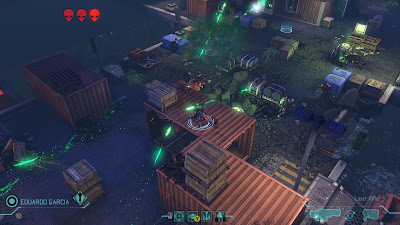
Like the original XCOM, all the gameplay in Enemy Unknown takes place in one of two settings. The first is the "world view", where you can manage your personnel and resources, and decide how to respond to threats like UFO detections, alien abductions, and terror attacks. The second is the "mission view", where your forces engage in turn-based tactical combat against a field of alien opponents.

In original game, each soldier began his or her turn in combat with a fixed budget of "action points", which could be carefully doled out for everything from walking to shooting to rearranging the grenades in your fanny pack. In Enemy Unknown, everyone gets to perform at most two movements, and/or one other action such as attacking or reloading.

One thing that compensates for this change is the new cover mechanic, wherein objects in the environment offer either full or half cover, allowing for combatants to be flanked depending on the direction of their protection. The result allows for combat that is just as tactically rich as the "action point" system, while being much faster paced and simpler to control. It also results in combat that looks and feels much more realistic and natural.

#2: Soldier classes and abilities

One of the concerns many fans had about Enemy Unknown was the reduced squad size. Instead of being able to roll in to a UFO crash site with enough grunts to fill out an active baseball roster, Enemy Unknown starts you with only four soldiers per mission, with the possibility of eventually upgrading to six.

The Heavy. (How you like me now?)

Fortunately, the future soldier of 2015 is much more capable and versatile than the future soldier of 1999. For example, your troops in Enemy Unknown are assigned classes that allow them to perform specific roles, namely "Assault" (first strike run-and-gun critical hitters), "Heavy" (machine-gun wielding, rocket-launching human tanks), "Support" (tactical experts and field medics), and "Sniper" (headshotting angels of death). Moreover, as each soldier gains ranks, they can unlock special abilities such as improved defense and extra attacks. Late in the game, having a medic that can carry three medkits instead of one or a sniper that gets to take two shots in a turn can mean difference between your squad heading home victorious and your squad ending up a pile of melted plasma on the ground.

#3: Refined inventory management

Being somewhat obsessive-compulsive, in the original XCOM I used to fully enjoy the 20 minutes before each mission I spent manually placing every weapon, ammo clip, and grenade in every utility belt and backpack my soldiers were carrying. However, I'll concede it did hamper the pacing of the game somewhat. In Enemy Unknown, most of the minutia of inventory management are taken care of for you. For instance, each soldier is limited to two weapons determined by their class, as well as armor and one additional item (e.g. a grenade or medkit). While this may sound restrictive, I found it actually improved gameplay by forcing me to learn the nuances of each weapon type and to be a more careful how I used one-shot items like grenades.

The streamlined resource management extends to the meta-game as well. Gone are the days when you had to order individual missiles for your interceptors, or worry that your soldiers might storm into their next battle with plenty of guns but no ammunition. Such issues apparently are handled automatically by your underlings, leaving you to worry about more important matters like which technologies your labs should research, which vehicles and facilities you should spend your shoestring budget on, and most importantly, how to keep political pressures from tearing apart the uneasy international alliance whose funding keeps the lights on at XCOM central command.

#4: Overarching narrative

One of the things I loved most about the original game were the storylines that emerged directly from the gameplay, like surviving a challenging mission because one of your rookies nails a lucky shot, or botching a routine UFO recovery when one of your senior officers turns out to be a coward. Enemy Unknown has managed to re-create this part of the classic XCOM experience, and even enhanced it a bit with subtle touches like squad member nicknames and a memorial for fallen soldiers. (In fact, you can check out my squad's story in this recent post.)
If "love is a battlefield", then prepare for some of the roughest loving you've ever experienced.

However, Firaxis also has worked to give a sense of narrative to the campaign as a whole. Rather than trying to lead the human race to victory by randomly researching technologies and attacking every UFO in sight, you can listen to your advisors to get an idea of how all these pieces fit together and what primary objectives will move the plot along. As with the extended in-game tutorial (which spans many hours and multiple missions), Enemy Unknown manages to add this extra level of guidance with a light enough touch to keep it from becoming too much hand-holding.

#5: Updated visual design

Improving the look of a game is one of the most obvious things a remake can do. In fact, Enemy Unknown is somewhat modest in this respect, with graphics that are solid but certainly not state-of-the-art.

Where this remake really excels, though, is in its environments and atmosphere. Each mission is a vignette, conveying its own sense of a world under siege through each abandoned gas station, crumbling cemetery, and burned-out bookstore. Even when you finally start to cycle around to maps you've seen before, variables like weather will make them seem fresh.

What didn't work so well?

As a critic, I would be remiss if I didn't point out some of the places where the design of XCOM: Enemy Unknown doesn't quite deliver. One of the things I found bothersome was that you can only shoot at hostile targets within your visual range. This limitation undermines some of my favorite classic XCOM plays, like shooting out a wall to get a better line-of-sight, or taking a Hail Mary shot from across the field.

Another issue is that when you first spot a group of aliens they're allowed an extra, instant move to take cover positions. Aside from being annoying, in close quarters you can end up with your squad standing idly by while a hulking Muton Berserker trots past your carefully organized defenses without encountering so much as a disapproving glance.

Oh... and I almost forgot to mention that the final level is pretty much total bullshit.

Summary

To wrap up this already way-too-long review: XCOM: Enemy Unknown isn't a perfect game, but it may be the best remake I've ever seen. Firaxis took on a huge challenge in updating one of the most beloved PC games in history, and they pretty much nailed it. It's so good that I could see myself never playing the original XCOM again... and when it comes to high praise for a remake, it doesn't get any higher than that.

Tuesday, October 9, 2012

Review: Borderlands 2

At times tightly designed and brilliantly executed, while at other times uninspired and juvenile, Borderlands 2 is an idiot savant of a first-person shooter.
On the lawless border world of Pandora, four "vault hunters"—a soldier, an assassin, a brute, and a powerful sorceress—are on a quest to find an legendary alien treasure. Guided by a mysterious artificial intelligence and assisted by a bizarre cast of supporting characters, these four brave adventurers battle feral creatures, psychotic bandits, and the forces of an evil corporation as they search for the mythical Eridian Vault and its promise of immeasurable wealth and power.

This little tale was the premise of the original Borderlands, and having sunk a lot of time into the first game, it is a story with which I am quite familiar. Consequently, I was somewhat disappointed when I realized a few minutes into the introduction of Borderlands 2 that this was also the premise of the sequel.

However, after spending a lot more time with the second game, I realized how wrong I was. Borderlands 2 isn't really about vault hunters, nor is it about "Handsome Jack" (the game's narcissistic, sociopathic, endlessly chatty villain), nor is it a commentary on imperialism and corporate greed, nor is it about murdering lots of dudes to snag color-coded loot. (Well, maybe it's a little bit about that last thing.) Rather, Borderlands 2 is about expectations, and why you should put yours aside when you play this game. It's also about an inbred chubby-chasing mechanic named Scooter.

I'm convinced that understanding this man is the secret to understanding Borderlands.

Like the original, Borderlands 2 is a self-styled "role-playing shooter" (RPS), combining the gameplay of a first-person shooter with the kinds of leveling systems, random weapon drops, and quest structures more traditionally found in role-playing games. Throughout the game's fairly linear mission structure ("go to point A, kill thing B, repeat") you'll encounter a variety of bizarre characters, such as an unbelievably annoying and foul-mouthed tween of a demolitions expert, a cyborg anthropologist who comes across more or less like a black Rudyard Kipling (how's that for irony?), and the four vault hunters from the original Borderlands (formerly a bland collection of nearly mute player characters, now somehow infused with distinct personalities).

However, the character I found most intriguing was Scooter, who reprises his role as the redneck proprietor of the "Catch-A-Ride" vehicle creation system. Scooter is friendly, talkative, funny, secretly romantic, and likely quite inbred, which is unsurprising given the occasional allusions to his incestuous urges. Despite his affable nature, he's got a casual murder or two under his belt, indicating that he's achieved the same level of moral flexibility exhibited by everyone else on this brutal wasteland of a planet. Also, he's a savant when it comes to engineering, and he seems to be one of the only people around capable of dealing with Pandora's incredibly advanced technology. In short, Scooter is Borderlands 2: an uninspired, frequently predictable stereotype full of crass behavior and juvenile dialogue, but one that also exhibits flashes of true technical genius, genuinely funny comedy, and uncharacteristic emotional depth.

Borderlands 2 may be the smartest dumb game I've ever played.

All of this brings me back to my original point about expectations. It would be easy to say that Borderlands 2 is simply "more Borderlands", because on a certain level that's the truth. It would be similarly easy to view it as yet another first-person game with RPG elements (à la Mass Effect, Bioshock, Fallout, or Deus Ex), with a repetitive mission structure and too much hand-holding. Likewise, it would be perfectly reasonable to take in the game's gratuitous violence, meet its over-the-top characters, and listen to their many jokes that fall flat more often than not, and then find yourself turned off by a title that seems like it is simply trying too hard.

A better approach, though, is to put your expectations aside and leave yourself open to the true moments of brilliance that can be found in Borderlands 2. It can be found in the expertly balanced combat, the amazing diversity of weapons (with their impressive array of custom reloading and firing animations), or among the many subtle improvements Gearbox has made to the enemy AI. It can be seen in the franchise's unique "concept art" graphical style, which feels more lovingly hand-drawn yet stylishly hyper-real than ever. It can be found in a ninja assassin who speaks only in haikus and emoticons (which is who I played most of the game as), and in a villain who turns out to be a much more complicated brand of douchebag than he originally seems. And of course, sometimes that brilliance can come from a porn-addicted hillbilly mechanic and amateur poet named Scooter, who helped me save the world of Pandora while making me laugh out loud more than once.

Friday, September 21, 2012

Review: Mark of the Ninja

Mark of the Ninja not only perfects the stealth genre, it transcends it, such that even non-stealth-game fans are likely to enjoy its rewarding gameplay and captivating atmosphere.
"Fun" and "rules" are two concepts frequently placed at odds with one another, and yet one of the basic truths of video games is that they are fun because they have rules. Video games are simulations of various realities, built on sophisticated systems. Understanding the parameters and limitations of these simulations—what actions are and are not allowed, and what responses we should and should not expect—is often an essential part of successful and enjoyable gameplay.

A genre where rules are exceedingly important is the so-called "stealth game". In a typical stealth game, the player controls a vulnerable (though often quite powerful) character whose primary charge is to ambush, hide from, and/or otherwise circumvent adversaries using methods besides direct confrontation. For this type of gameplay to be effective, there has to be a well-understood set of rules. How can I tell if I am adequately hidden? What actions will cause an enemy to sense my presence? If I am detected, what are the consequences? When these rule sets are skillfully designed and well communicated to the player, stealth games become a challenging organic puzzle that tests the player's capacity for deceit and subterfuge. When they are not, stealth games become a vehicle for limitless frustration that test the player's capacity for anger management.

Mark of the Ninja is a 2D action game that implements the essential design elements of the stealth genre impeccably. Developed by Klei Entertainment (makers of the Shank franchise) and available via the Xbox LIVE Marketplace, Mark of the Ninja follows the Champion of the Hisomu ninja clan in his quest to destroy a powerful private military corporation that has assaulted his ancestral home. To fulfill his duty, the Champion must disable scores of heavily-armed guards, evade deadly and devious traps, and circumvent high-tech security measures.

Enemies can be distracted in a variety of ways. Investigation of mysteriously damaged floodlights and unexpectedly sounded gongs is a leading cause of guard-related death in this game.

Though his mission is daunting, the Champion is well equipped for the task at hand. A gifted ninja with superhuman abilities derived from his mystical tattoos (called "marks"), the Champion can effortlessly scale ceilings and walls, fling bamboo darts with unerring accuracy, and execute an unsuspecting enemy in complete silence. Despite this impressive list of powers, he's hardly invincible; if a misstep or botched kill raises the alarm, a burst or two from a mercenary's assault rifle kills him as dead as anyone else.

It is in its understanding and expression of the player character's advantages and limitations that Mark of the Ninja truly excels. When performing noisy actions such as sprinting or using your grappling hook, blue circles indicate the radius within which these sounds will alert a guard. When standing in light or darkness, the Champion's visibility to a foe is clearly apparent. In other words, whenever you end up dead on the ground with more holes in your face than nature intended, it's pretty much always because of a careless step or a flawed strategy, and you'll know exactly what went wrong.

Attacking an unsuspecting enemy results in a stylish instant kill animation. Attacking a suspecting enemy usually results in getting your head blown off and reloading at a checkpoint.

In addition to the expertly implemented systems for player feedback, Mark of the Ninja has a pretty generous checkpoint system, which typically responds to your untimely demise by restoring you to the point just before everything went all sideways. Together, the feedback and checkpoints encourage a satisfying level of experimentation and choice. If I let that guard catch a glimpse of me, can I return to the shadows quickly enough to sneak past him when he comes over to snoop around? If I hang this guard's corpse from that lamppost, will it terrify those other two guards enough that they'll accidentally shoot each other? I often found myself repeating a section multiple times not because I couldn't complete it, but rather out of a desire to complete it as elegantly as possible. (Yes, I realize I just used "elegant" to describe the act of hanging corpses from streetlights.)

The artfully refined mechanics of Mark of the Ninja would add up to a pretty fantastic experience irrespective of graphics and story; however, the game manages to deliver on these other fronts as well. The characters are masterfully illustrated in Klei Entertainment's trademark comic-book style, and the richly layered environments possess a sense of purpose that embraces the visual extremes of light and dark. While for some games, the graphics are the point of the game, for Mark of the Ninja, the graphics communicate the point of the game, by taking the practical requirements of the world and restating them in a visually compelling way.

The story of Mark of the Ninja is also impressive for such a mechanical game, though it shines somewhat less spectacularly than the graphics. The characters are as well acted and are developed about as deeply as one can expect from a handful of cut-scenes and some limited instructional and expository dialogue, most of which involves a stereotypically taciturn ninja clan. The plot is similarly pragmatic, although it contains a few twists that, while fairly predictible, are thoroughly appreciated in a game that could have just as easily have ignored narrative altogether.

The environments of Mark of the Ninja are a triumph of utilitarian design: beautifully rendered, yet wholly committed to the game's essential purpose.

To summarize: Mark of the Ninja refines the stealth game to its functional zenith, and like all great feats of design, achieves in its complexity a certain simplicity. I believe that the elegance of its mechanics, along with its diverse opportunities for player experimentation and appealing aesthetic trappings, allow it to appeal to a wide audience. If you think you might enjoy pretending to be a bad-ass master ninja—which I'd like to think is pretty much everyone—then Mark of the Ninja is a game for you.