Showing posts with label Bethesda. Show all posts

Friday, November 2, 2012

Review: Dishonored

Though it suffers from some of the common issues of first-person stealth games, Dishonored's rich world and engaging gameplay make it well worth your time.
I've always found extremely frustrating the style of gameplay typically engendered by stealth elements. In games like Metal Gear Solid or Assassin's Creed, no matter how hard I try, I find there's a huge gap between the player I want to be and the player I actually am. The player I want to be is a cunning, graceful, and deadly phantom who strikes fear into the hearts of his enemies. The player I am is the guy who accidentally alerts the first guard he encounters and then is forced to clumsily mass-murder everyone in the room.

For stealth to work well, a game needs to be designed with clear, reliable mechanics paired with intuitive systems for player feedback, which is why the XBLA title Mark of the Ninja released earlier this year was such a phenomenal game. These requirements are also why I find first-person 3-D stealth games like Thief and Deus Ex to be problematic—in this setting it's much harder to design good mechanics for visibility and to communicate when the player is hidden and what actions will cause them to be detected.

However, both Thief and Deus Ex are highly acclaimed works, because they create captivating worlds and then give us the breath of gameplay choices to interact with these worlds in a variety of interesting ways. Consequently, even though I suspected Dishonored might suffer many of the canonical pitfalls of first-person stealth games, I felt it only fair to give it the same chance to impress me with its world and the things I might do in it.

Let's start with a bit of background: Dishonored is set in the fictional city-state of Dunwall, a industrial-era Victorian sort of place where everything is powered by magical whale oil. Unfortunately, all this blubber-driven technology has little effect on a devastating plague that is decimating the city, and things quickly go from bad to worse when the Empress of Dunwall is murdered and you, her personal bodyguard and occasional boy-toy, are blamed for it. Shortly before your impending execution, standard video game tropes finally work their magic a grant you a means to escape, new weapons and gadgets, and supernatural powers, i.e. everything you need to go on a murderous campaign to seek revenge on the people that ruined your life and betrayed your country.

Dunwall is like the England of Charles Dickens crossed with the England of Children of Men.

I won't ruin the rest of the story except to say that there are a few plot twists, though I found them all to be fairly predictable. (And mind you, I'm the sort of person who rarely guesses plot twists beforehand.) However, what Dishonored lacks in story it more than compensates for in terms of ambiance and gameplay.

First, regarding ambiance: a lot of games do post-apocalyptic and pre-apocalyptic well, but rarely does one get a chance to enjoy straight-up apocalyptic. Dishonored does a great job of creating a city on the brink of total ruin, from the rat-infested slums to the lavish brothels and mansions where the aristocracy fortify themselves against the diseased masses. While other games might use such a setting as an opportunity for pointed social commentary, Dishonored seems content merely to use this world as a colorful backdrop for your personal quest for justice and revenge. This earnest portrayal, combined with well-written, superbly acted dialogue and a slightly stylized, hand-painted art style (think "disturbed Norman Rockwell"), make the world of Dishonored a very real and very fascinating place to inhabit.

After playing these kinds of games for a while, I find that I check my six a lot more often.

Second, regarding gameplay: as I'd originally feared, Dishonored makes a lot of missteps in their version of the traditional stealth mechanics. It's often difficult to tell at a glance if you're hidden or not, and the visual and audio cues that indicate an enemy has spotted you are subtle and easy to miss. More than a few times, while lying in wait to launch a devious attack on an unsuspecting guard, I was interrupted by being stabbed repeatedly in the back of the head by some guy I didn't even know was there. If you're trying to get through the missions clean, save frequently and be prepared to look at the loading screen a whole lot.

However, in many ways Dishonored is able to compensate for these issues by offering a diverse array of additional mechanics, allowing for the sort of player-choice-driven gameplay that made games like Thief and Deus Ex so successful. For example, imagine you're trying to infiltrate a particular building with the intent of sending one of your former colleagues into forced retirement. You might choose to use your mystical dark powers to (a) possess a rat and crawl in through a broken vent, (b) teleport to a second story ledge and sneak in through an open window, or (c) freeze time and then plant an exploding razor mine on the chest of the guard at the front door. Dishonored also takes great pains to extend this level of player choice to each mission as a whole. Each target has a number of ways they can be dispatched, from a simple knife to the face, to creatively engineered "accidents", to non-lethal (but often far more cruel) methods, which involve dropping the hammer of poetic justice on your adversaries by using the very things that made them powerful against them.

Here's an example of some guards "troubleshooting" a security barrier you've tampered with.

In fact, games elements like these "non-lethal" objectives are indicative of how Dishonored manages to still be successful without "solving the stealth problem". Even though I could have eschewed the temperamental stealth mechanics entirely and just cut a bloody swath through Dunwall head-on, the prospect of secretly getting my revenge without ever being seen or getting my hands dirty held a certain allure. (Also, there was the temptation of getting the "Ghost" achievement for not being detected or taking a life the entire game.) And for an imperceptive stealth-impaired klutz like myself, the fact that Dishonored managed to keep me happily skulking around rooftops for about 30 hours should be pretty high praise indeed.

Friday, September 14, 2012

My Fall Preorder Lineup

Or: How I Learned to Stop Worrying and Love the Preorder

I've gradually grown to love "preordering" upcoming titles before they're released. Originally I viewed the practice as a way for desperate Gamestop employees to harass you at the register, by running through all the additional games they'd like you to buy beyond the one you were actually holding. As I started buying most of my games online, I became more willing to drop a bit of pre-release coin in exchange for various discounts and bonuses.

Today, I'm a straight-up preorder addict. I buy upcoming titles on Amazon as soon as I know I want them, without regard to whatever preorder bonuses may or may not materialize. (More than once, I've ordered games so far in advance that they've been delivered to a previous address several months after I moved.) Every release date is like a little mini-Christmas, and the UPS guy is my own personal Santa in brown short-pants. Here's a quick run-down of the titles I'm expecting to show up on my doorstep between now and the end of 2012.


Game: Borderlands 2
Platform: Xbox 360 / PS3 / PC
Release Date: September 18, 2012
How I Feel About It:   Cautiously Optimistic

Released in 2009, the original Borderlands received a fair amount of acclaim for its distinctive visual style and its skillful integration of RPG elements into solid first-person shooter gameplay. Also, from what I heard, when experienced at its finest, the four-player co-op bordered on transcendental. Unfortunately, this was never my experience, as the difficulty scaling was so aggressive that to play with anyone a few levels above or below you was either prohibitively challenging or pointlessly easy. Furthermore, the bare-bones plot and repetitive mission structure left me pretty unsatisfied with the single-player experience. Still, there was a whole lot about Borderlands that reeked of promise, and if its sequel can fix some of these missteps while building on the potential of the original, it could turn out to be one of the best games of the year.


Game: XCOM: Enemy Unknown
Platform: Xbox 360 / PS3 / PC
Release Date: October 9, 2012
How I Feel About It:   Sporting a Raging Nostalgia Hard-On

If you've ever spent any time talking to a PC gamer, chances are they've mentioned XCOM at some point. Originally released in 1994, XCOM was a turn-based tactical strategy game that revolutionized the genre, while simultaneously keeping my friends and I up playing into the wee hours, terrified that at any moment a Cryssalid would burst out of the monitor of my Tandy desktop and impregnate us with its zombifying alien toxins. This upcoming remake of the original has been lovingly developed by the capable hands at Sid Meier's Firaxis Games, the folks behind the Civilization series. All signs point to this game being a slam dunk, and for the developers' sake I sure hope so... should it disappoint, an army of XCOM fanboys stand at the ready to unleash a flood of impotent Internet rage.


Game: Dishonored
Platform: Xbox 360 / PS3 / PC
Release Date: October 9, 2012
How I Feel About It:   Skeptical, But Intrigued

Dishonored is a first-person stealth/action-adventure game developed by Arkane Studios and published by Bethesda Softworks. I hadn't heard about this game at all until this year's E3, and I'm still a bit skeptical. If there's two things that first-person games tend not to excel at, it's stealth and melee combat. (Fans of the Thief games would probably disagree with me here.) Still, the impressive screenshots and industrial-era setting—along with the fact that it's one of the few new games this year that's not a sequel—piqued my interest enough to go with Dishonored as my impulse buy for the fall.


Game: Assassin's Creed III
Platform: Xbox 360 / PS3 / PC / Wii U
Release Date: October 30, 2012
How I Feel About It:   Brimming With Revolutionary Bloodlust

Being a New Englander, any game where you run around revolutionary-era Boston murdering Redcoats is going to get four out of five stars from me just for showing up. Sure, the Assassin's Creed series started to get a little stale after Ubisoft released a second follow-up to Assassin's Creed II, but it's still a rock-solid franchise, and everything I've been hearing about this game indicates that the developers have taken nothing for granted. For now, I'm going to allow myself to revel in unchecked enthusiasm for this game, fully confident that it's going to turn out to be phenomenal.


Game: Halo 4
Platform: Xbox 360
Release Date: November 6, 2012
How I Feel About It:   Glad It's Not Call of Duty

I never thought of myself as a huge Halo fan, usually preferring to scratch any competitive multiplayer itches with the Gears of War games. However, my friends and I have recently gone back to playing Halo 3 during our weekly online play-date, and I was quickly reminded of what an amazing game it is. As someone who is thoroughly bored of the whole Call of Duty thing, I'm picking Halo 4 over Call of Duty: Black Ops II as my preferred multiplayer shooter for the holiday season. (If my friends are reading this... you now know what to tell your wives you want for Christmas.)


As you can see, I've got my work cut out for me for the rest of 2012. (I'm actually glad Bioshock Infinite got pushed off to February.) Looking at this lineup, it makes me wonder what kind of space is left in the marketplace for the Nintendo's new console (the "Wii U"), which they just announced will be available November 18. Regardless, there will probably be no U for me... my dance card is full.

Wednesday, November 16, 2011

Review: The Elder Scrolls V: Skyrim


For anyone addicted to release-date gaming, this November has been a grueling month, each week stuffed to bursting with high-profile new games. It’s been the kind of hectic month that April is for certified public accountants, though probably with a lot more software patches. 

This week, we’ll be running the numbers on Skyrim, the fifth and latest installment in Bethesda Softworks’ flagship role-playing franchise The Elder Scrolls. (Note that this is the last time I will use the word “scrolls”, because like Notch (the indie developer behind Minecraft—I don’t feel it particularly embodies the spirit of the series. Plus I’m afraid of getting sued.)

Design: 5/5

If you’ve never played Bethesda games (such as Morrowind, Oblivion, Fallout 3, or New Vegas) before, they’re best summed up by one word: MASSIVE. Starting a Bethesda game is like reliving your own birth: after a short tutorial in a safe, warm dungeon, you are expelled into an enormous and confusing world full of hostile beings, most of whom are trying to kill you. Like its predecessor Oblivion, the game world of Skyrim spans about 16 square miles to scale (approximately two-thirds the size of Manhattan) and has around 150 dungeons, nearly all of which are completely accessible from the moment you step out of your little instructional womb. While environments this expansive are impressive for any role-playing game, they come across as even more amazing when presented in this unfettered open-world style.

In Skyrim, the shortest distance between two points almost always involves a mountain.

The down side of a game this enormous is that technical glitches are almost a certainty. Like past Bethesda games, Skyrim has its fair share of bugs, though in my experience they’ve been of stereotypical and fairly harmless varieties, such as occasional missing textures, erratic AI behavior, and one or two “outside the map” glitches. I found they had little impact on my gameplay—especially for a compulsive game-saver such as myself—and so far I’m inclined (as with other Bethesda games) to overlook them.

What really impresses me about the design of Skyrim are those few minor changes made from Oblivion that have had an enormous impact, such as improvements to the leveling system. In Oblivion, your character gained a level whenever he/she had sufficiently advanced specific favorite skills. However, the improvements to your statistics (e.g. strength or dexterity) depended on how much you had improved those and other skills. For example, let’s say you were a heavily armored, warhammer-wielding orc. If you wanted to make sure that by level 40 you were at least as dexterous as your average severe stroke victim, you couldn’t just work on increasing your “speed” attribute as part of normal gameplay. Instead, you had to go off and pick 100 locks or spend 15 minutes swimming in circles whenever you were about to advance to your next level. In Skyrim, on the other hand, most of your attributes are derived from your skills. If you start off as a mage but decide later to dabble in a little swordsmanship, it won’t take much practice before your spindly, atrophied arms are swinging that broadsword like a pro. It’s a subtle difference that has a huge effect on the gameplay.

Artistic: 4/5

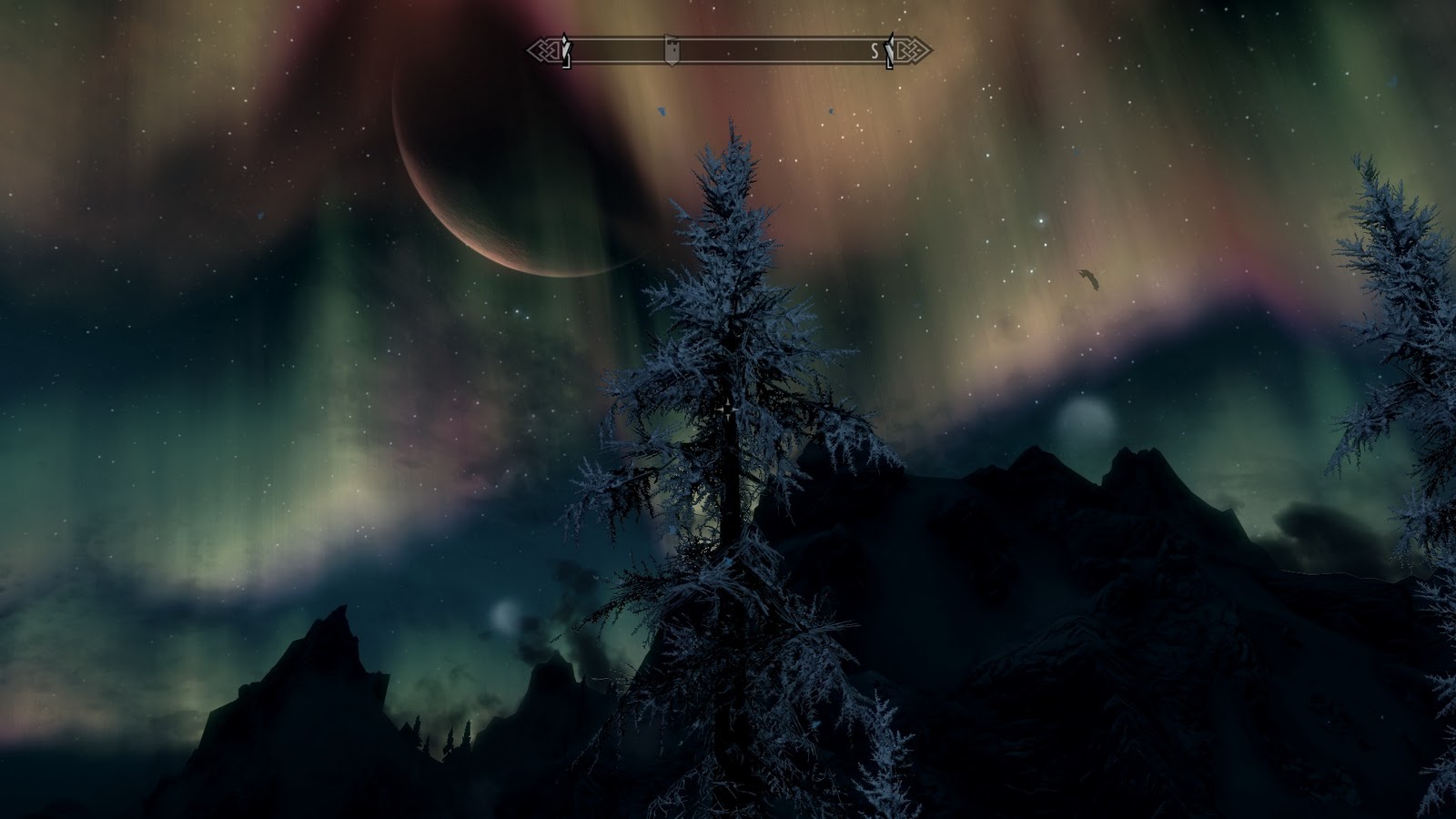
Aesthetically, the province of Skyrim is cold, blue-tinged, and harshly lit, like someone took a Jason Bourne movie on an arctic expedition. Hiking along icy rivers and up jagged mountains, I found the landscape to be dangerously beautiful—the kind of place that makes you want to let your guard down and enjoy the view, and then murders you with a savage pack of snow wolves. Just to give you an idea of how much of an impact these visuals had on me: whenever my character stepped out of the cold to sit by the fire of the nearest mead hall, in real life I actually felt warmer.

So pretty, I’ve almost forgotten about that polar bear that’s about to rip my head off.

From a purely technical perspective, however, the graphics of Skyrim certainly aren’t groundbreaking. Look too closely, and you’ll find plenty of sub-standard elements, like lackluster textures or rocks that appear to be made with only a handful of polygons. It’s a bit of a problem, and one that’s exacerbated on the Xbox 360 by the texture loading issues with hard-drive installations (for which there will apparently be a patch). Nevertheless, what Skyrim lacks in brute force, it makes up for in finesse.

Narrative: 4/5

The question of narrative is a difficult one for a game like Skyrim. A “story” is basically a distillation of reality with respect to a particular point of view. How do you tell a single story when you’ve created an entire world? In other words, a concept as limiting as “plot” is almost too small for Skyrim.

Oh, I see now... it says “dragon” right up there.
And here I thought I was fighting some other kind of giant, scaly, fire-breathing thing. 

Of course, there is an over-arching story line, which to be completely honest, I haven’t even finished yet (and it’s within the realm of possibility that I may not do so for the next 80 hours of gameplay). It seems reasonable enough, plodding along with some forgettable characters and mediocre voice acting. From what I have gleaned so far, it has something to do with dragons, which is really the only thing you need to know, because it means you get to have a blast killing some dragons.

For me, the meat of the game is really the ridiculous number of “side quests”, so much so that they should probably just be called “quests”. There’s an amazing number of things you can do, such as become a mercenary, join a secret brotherhood of assassins, go to college to be a mage, or fight in a rebellion against (or for) the Imperial army. From a narrative point of view, the only issue with all these choices is that a completionist like me will want to do them all, meaning that by the end of the game, your character ends up as some sort of ridiculous mercenary-assassin-wizard-rebel-type person, i.e. a schizophrenic.

Gameplay: 5/5

In Skyrim, gameplay has three main aspects: exploration, character development, and questing. Much of the game follows a basic yet rewarding formula: wander around until you find a dungeon, slay its inhabitants while you gain a level or two, and then rifle through the resulting mountain of corpses and steal anything of value. If you’re the sort of person who thinks that “fun” is spending a few hours wandering around hunting enough animals for pelts and picking enough herbs to make yourself a nice little leather cuirass and matching health potion, then Skyrim is for you.

Don’t be fooled. Just because those NPC’s look different, it doesn’t mean they aren’t all voiced by the same actor.

While Skyrim—like most Bethesda games—isn’t really about combat, there have been some definite improvements that make it much more palatable. The most notable is the ability to dual-wield. For instance, instead of a sword and a shield or a two-handed weapon, you could choose to fight with a sword and a fistful of fireballs, or by casting a different spell with each hand. When combined with the option to “favorite” certain items and spells in your inventory, the dual-wielding makes playing the game as a mage almost a reasonable option... almost.

Summary

If you’ve played and enjoyed Bethesda games before, then Skyrim shouldn’t disappoint. If you haven’t—but do fancy yourself an RPG fan—then Skyrim’s obvious improvements over past games make it an excellent place to start. Just be sure to bundle up, because it’s a bit nippy out there.